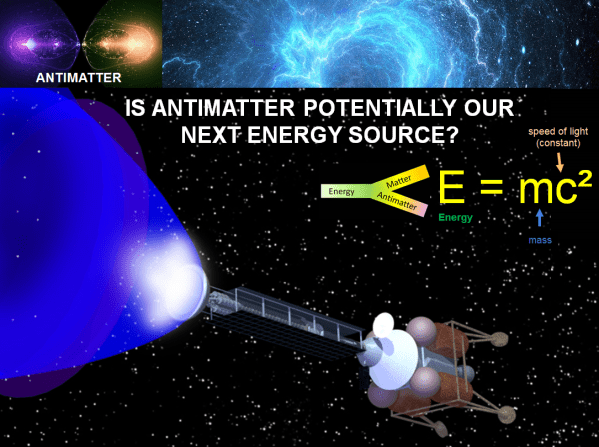
The answer to the question in headline is: NO. What you'll read next is the reason why not. Basically it's quite simple to grasp why this is out of reach. First of all is because we don’t know much about it, and second we simply don’t quite understand how antimatter behaves really nor we could... Continue Reading →
Blog Feed
Is an Antimatter Bomb Viable? The Science Behind It
To many people, antimatter probably sounds a lot stranger than it really is. before to answer the question in the headline let me quickly say what antimatter is and does. In it's most basic sense, antimatter is just matter with its electrical charge reversed. When antimatter comes into contact with matter, the result is: annihilation. Then... Continue Reading →
What is Antimatter? Exploring Its Mysteries and Significance
Antimatter is not the stuff you interact with, the same as you do with matter. It was for long time and still is a hot topic for science fiction stories. However this stuff is experimantally confirmed to be real and it definitely worth to learn more about it. So what is it?. I will try... Continue Reading →
WHY IS ANTIMATTER SCARCE IN THE UNIVERSE?
Periodic Table of Elements represents our knowledge about matter. There is still a lot to learn about and new stuff to discover but in general we are quite familiar with matter. We know well that ordinary matter is the familiar stuff, which makes air, rocks, and living things. But the opposite as we call it... Continue Reading →
Did Antimatter Cause the Tunguska Disaster?
In the universe there is a lot of stuff we know nothing about or we know very little. One of them is the thing called Antimatter. We only discovered its existence almost a century ago. Today we know it is there, but more than some basic characteristic properties just enough to have a clue about it,... Continue Reading →
H – What does the color spectrum of Hydrogen mean?
Before to elaborate on the topic in the headline of this article, let me just remind that the Hydrogen element is an odorless and colorless gas. If observed in the Universe in the interstellar space it can give a pinkish red glow, this being only a visual effect created when Hydrogen is projected by the... Continue Reading →
H – Why Hydrogen Fuel is better than Fossil Fuels?
Hydrogen is by far much better than any other fuel we use. When burned in combustion the only emission it generates is water vapor so obviosly is the cleanest element 100% Eco-frienly we can ever get. The only problem is how can we get it in a clean way and use it as fuel. To... Continue Reading →
H – Why is Hydrogen a nearly ideal fuel?
Have no doubt that Hydrogen is a versatile energy carrier. We just have to learn more about how to harness its power. We are used to think that difficult structures are also the most difficult to control. Well... Hydrogen is just teaching us the vice-versa. Elemental Hydrogen is the simplest and lightest atom in existence (made... Continue Reading →
H – The Drawbacks of Hydrogen
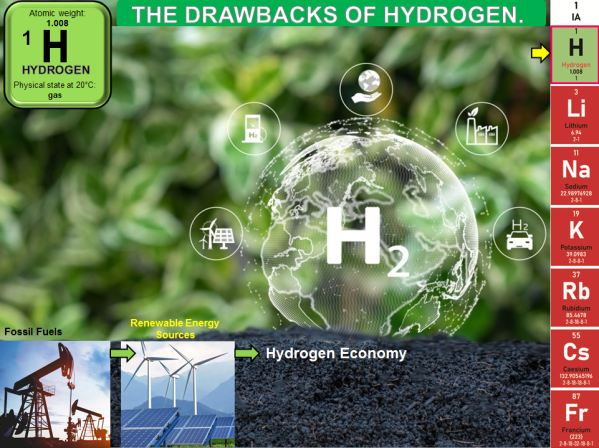
Does Hydrogen has any drawbacks which prevent us to have hydrogen economy? Striclty speaking about Hydrogen as fuel, the answer is NO. Elemental Hydrogen is the almost the perfect fuel. Hydrogen fuel is the most promising alternative fuel for the future. It has a high calorific value, It yields almost double the energy provided by jet... Continue Reading →
H – The Benefits of Hydrogen Fuel
In the last 100 years, we had so much energy available that we could simply afford the luxury of wasting it; But gradually that it is now running out and all the related environmental issues can no longer be ignored, something will have to change. And it MUST change. Our current level of energy consumption... Continue Reading →
H – How Flammable is Hydrogen?
Fire and explosions are exaclty what the Sun does. On Earth fire doesn't occur naturally that much like on the Sun, but we have it since the planet Earth exist. It is in volcanoes, in lightning strike or in wildfires ignited by the sun’s heat. Human species discovered fire so long ago that we can... Continue Reading →
H – The Challenge of Hydrogen Transport
In spite of important optimisations for Hydrogen Storage in the last couple of years, containing Hydrogen remains a challenge. In order to be contained effectively and used as fuel, hydrogen needs to to be kept either as gas at atmospheric temperature under high pressure or as liquid at lower pressure but at cryogenic temperatures, or... Continue Reading →
H – The Challenge of Hydrogen Storage
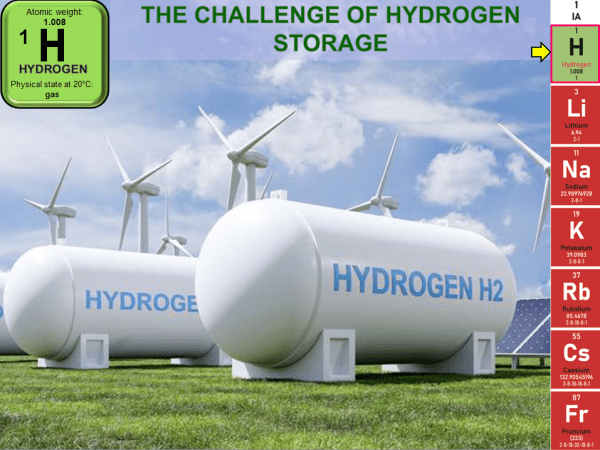
On Earth Hydrogen elemental Hydrogen is scarce. It is difficult to get and diffcult to handle. However there are plenty of sources easily available on our planet from where we can get Hydrogen. There a lot of it combined in molecules with other elements such as Oxygen (in water) and Carbon (in hydrocarbons) plus various... Continue Reading →
H – The (current) uses of Hydrogen
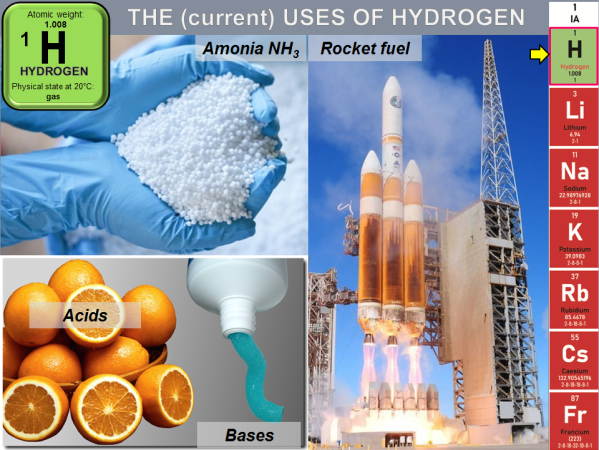
PAST USES Hydrogen gas is the lightest element of all. The prime components of air, nitrogen (N) and oxygen (O), are 14 and 16 times heavier, hence giving hydrogen a dramaticly high buoyancy. This lightness of hydrogen made it a natural choice for one of its 1st practical uses – filling hot-air balloons. No balloon... Continue Reading →
H – The Hydrogen Compounds
Hydrogen is abundant, being the most common element in the universe. The sun consumes 600 million tons of it each second. On Earth at normal temperature and pressure the element Hydrogen is a gas. Because of its atomic structure of 1 proton and 1 electron H is the lightest element in existence and has an... Continue Reading →
H – The characteristic properties of Hydrogen.
Hydrogen is the simplest, lightest and smallest possible atom in existence; it has only 1 electron and a nucleus of 1 proton. You can visualize a hydrogen atom as a dense central nucleus with a single orbiting electron, much like a single planet in orbit around the sun. Scientists prefer to describe the electron as... Continue Reading →
HYDROGEN (H)
In science simplicity and beauty are often equated and that's exactly the case for Hydrogen, which is the most compact and abundant element in existence. No doubt, Hydrogen is the numero uno, the ultimate The King of Elements. Its chemical symbol is the capital letter: H. Called in different languages its name is: Hydrogenium (in... Continue Reading →
THE 3rd STATE OF MATTER – What is a Real Gas?
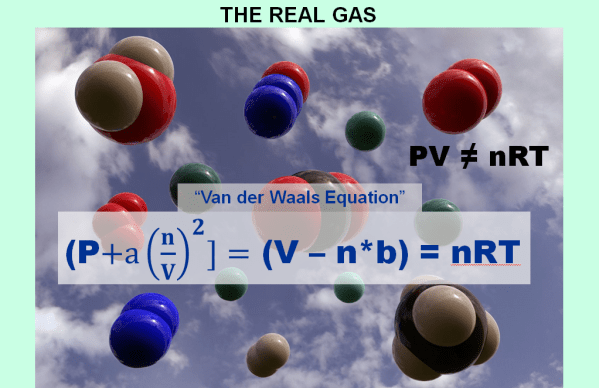
In any scientific discipline when we want to learn and understand the basic principle about how things work, we need a reference model defined in clear and simple terms so that it can be easily used and applied. When we deal with gases, the theoretical model of reference is called Ideal Gas. The Ideal Gas... Continue Reading →
THE 3rd STATE OF MATTER – What is an Ideal Gas?
Gas is the 3rd state of matter which has nor fixed shape neither a fixed volume. However gases are essential for many applications. In order to study, understand and keep a gas under control, we need to have a good study reference as starting point. And we do have that. The behavior or gases is... Continue Reading →
THE 3rd STATE OF MATTER – The 4 Laws of Ideal Gas
Gas is the state of matter with no fixed shape and volume. That means the particle in a gas aren’t particularly attached to one another being in a constant state of motion either inside of their container or as dispersed in space. However the behavior of matter in gaseous state is strongly influenced by at... Continue Reading →
THE 3rd STATE OF MATTER – GAS
Gases are all around us but most of the time we don't give them much thought. However, along with solids and liquids, gases are one of the main states of matter and the way they behave is vital for life on Earth. For example, when we breathe in, we increase the volume of our lungs,... Continue Reading →
MERCURY: On The Surface of The most Cratered planet our Solar System.
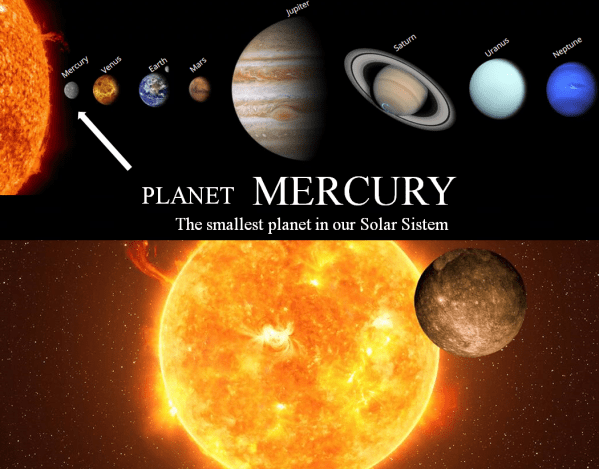
Mercury is one of the 4 terrestrial planet in our Solar System and also the one we didn't know much about until quite recently. As it is the smallest planet among the total of 8 and also being the closest to the Sun, Mercury was dificult to study. In early research, astronomers believed that Mercury... Continue Reading →
WHAT ARE THE NON-NEWTONIAN LIQUIDS?
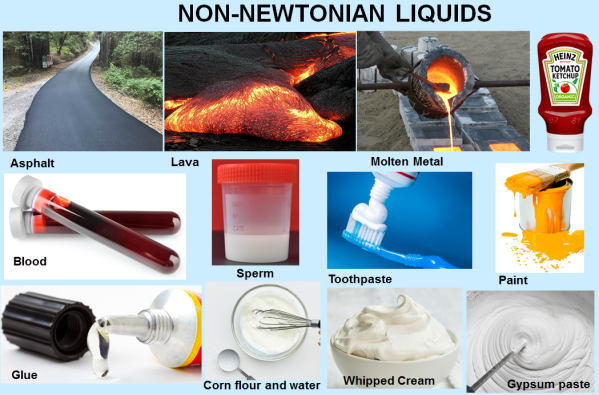
If matter is exposed to an external force such as shear stress also influenced by temperature and pressure, it tends to either have a plastic deformation or starts to flow. The volume of matter which continuously changes its shape under the influence of any force or stress, it flows and the substance is called fluid.... Continue Reading →
WHAT ARE THE NEWTONIAN LIQUIDS?
Liquid and gas are 2 different states of matter yet they have a lot in common. Both are fluid and both have free flow. In physics, the term fluid refers to any material that continuously changes its shape and form under the influence of any force or stress. The shear modulus of fluid is zero,... Continue Reading →
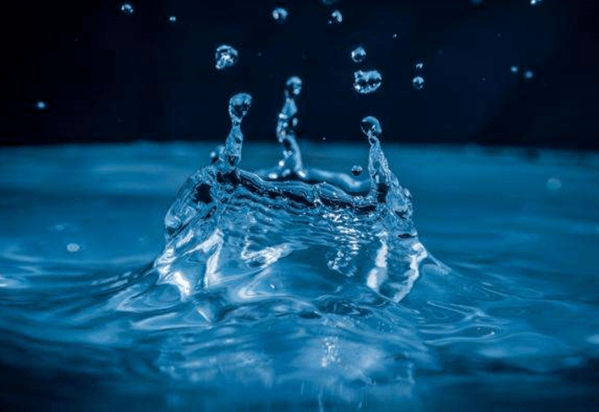
THE 2nd STATE OF MATTER – LIQUID
We usually use the terms liquid and fluid interchangeably in general to refer to a substance which is in a liquid state, such as water. However, there is a stark difference in both terms. In physics, the term fluid refers to any liquid, gas or other material that continuously changes its shape and form under... Continue Reading →
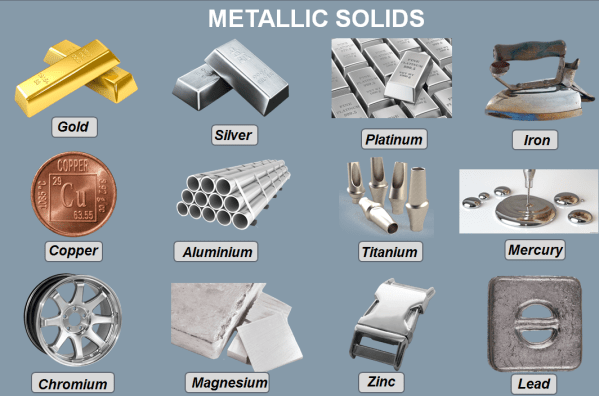
WHAT ARE THE METALLIC SOLIDS?
In this article Iet's talk about the most common type of solids: THE METALLIC SOLIDS. These are the ones which we use on daily basis. Just look around you and you'll notice that most man-made objects are either made of a metals or at least contain 1 metallic component. For example, your watch has metal... Continue Reading →
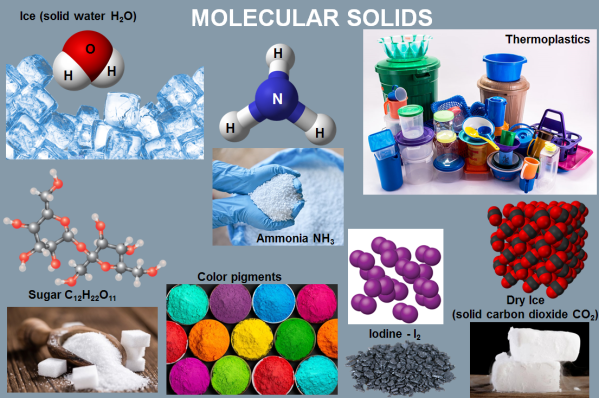
WHAT ARE THE MOLECULAR SOLIDS?
During the wintertime when it snows, if you are like most school kids, you get pretty excited about snowy days. On your day off, you might go outside and play in the snow as you watch the snowflakes fall. When a snowflake lands on your gloved hands, you can see the shape of the snowflake... Continue Reading →
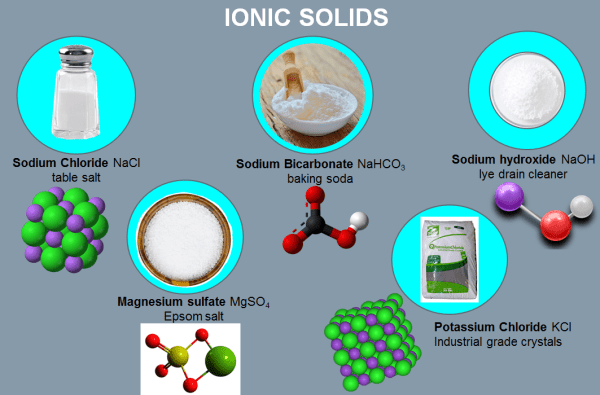
WHAT ARE THE IONIC SOLIDS?
The category of solids you'll read about next has very much to do with our food, simply because eat them. These are THE IONIC SOLIDS. Let just start with an example. Have you ever used Epsom salt to help with muscle soreness and stress? If you do, then let me tell you that Epsom salt... Continue Reading →
WHAT ARE THE COVALENT NETWORK SOLIDS?
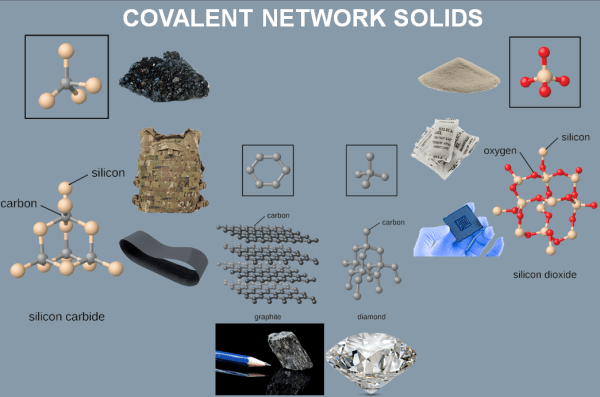
Solid is the 1st state of matter and also the most studied and used. Anyone entering into materials science engineering the 1st stage of study starts with learning and understanding solids. In my previous article I was briefly introducing the concept of SOLID, what is it, how does it occur and what are it main... Continue Reading →
THE 1st STATE OF MATTER – SOLID
The Periodic Table of Elements contains 118 elements we currently have knowledge about. 92 of them occur naturally on Earth , all the rest are artificially made. Most of the 118 elements at normal temperature (20°C) and pressure (1atm), occur in solid state, a few are gases and just 2 are liquid (mercury Hg and... Continue Reading →
MERCURY: The atmosphere on the smallest planet in our solar system
Mercury is a planet without much of atmosphere and its surface full of craters tells us about the great cosmic bombardment a.k.a. the Late Heavy Bombardment which is a hypothesized event thought to have occured approximatelly 3.9 billion years ago. It's not easy to find information about the early life of this globe, because Mercury... Continue Reading →
MERCURY: The 1st Planet from the Sun and smallest in our solar system.
All the technology we have so far is based on materials available on our planet. At least for now. However at one point in time as technology continues to advance we might be able one day to exploit natural resources available in our Solar Sistem. Except Earth there are 4 bodies outhere we can consider... Continue Reading →
MECHANICAL DESIGN ENGINEERING – Geometrical Dimensioning and Tolerancing_What is the TOTAL RUNOUT tolerance?
Runout is a very effective geometric tolerance which can be applied on any rotationally symmetrical parts. Depending on functional requirements, RunOut tolerance can be either measured on each individual point distributed arbitrary along the tolerated circular element which in this case is specifies as Circular RunOut tolerance. Or can be measured over the entire surface... Continue Reading →
MECHANICAL DESIGN ENGINEERING – Geometrical Dimensioning and Tolerancing_What is the CIRCULAR RUNOUT tolerance?
Runout is one of the oldest and simplest concepts used in GD & T. Maybe as a child you stood your bicycle upside down on the ground and spun a wheel. If you fixed your stare on the shiny rim where it passed a certain part of the frame, you could see the rim wobble... Continue Reading →
Why Lightning is Deadly?
When we travel by plane the cruising altitude is always above the clouds (at around 12.000 meters high). If your flight is on a full sunny day and you look downwards though the window at that height you either see the ground below or a white blanket of clouds. But that will quickly becomes boring,... Continue Reading →
LEAN MANUFACTURING – DESIGNING A CAR – Inventing something new
Inventing something new doesn' necessarily means that you come out with a revolutionaly product which nobody ever seen or though about before. Nowadays with so much tech available the possiblilty to really do so it exceptionally low. Yet improving an existing product adding features on it like no-one did before and create a memorable user... Continue Reading →
SOLIDWORKS_Viking Helmet
In this post I'll show you how to design a Viking Helmet made of 2 main componets :The Helmet Body and the Horn Body, which will make the final assembly in a Viking Helmet Product. Let's start with The Helmet!! THE HELMET STEP 1 Create new part STEP 2 Create 2 reference planes, each at... Continue Reading →
LEAN MANUFACTURING – DESIGNING A CAR – The Techniques of Lean Design
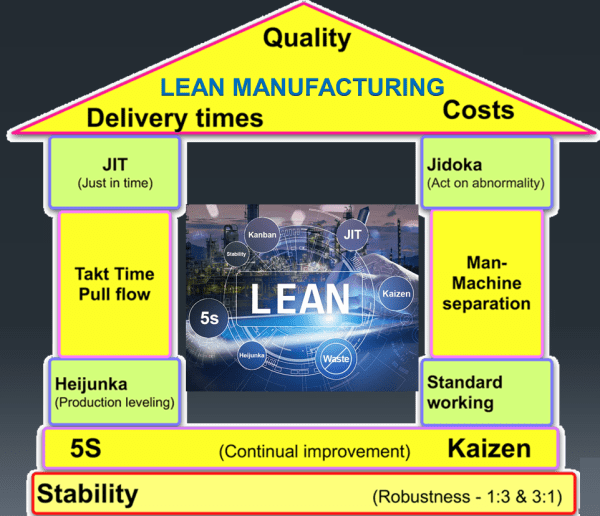
It's wonderful to know that new products can be produced faster with less effort and fewer errors. However, innovations are most useful when they are available to everyone and practices at General Motors, Volkswagen and the other mass producers, lag far behind. I know because myself I was doing this for years and during the... Continue Reading →
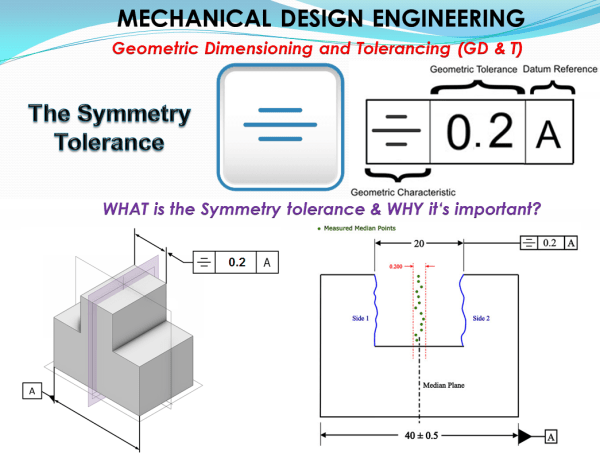
MECHANICAL DESIGN ENGINEERING – Geometrical Dimensioning and Tolerancing_What is the SYMMETRY tolerance?
Among the 14 used GD & T symbols in the category of Location Tolerances there are 3 types. 1. The Position Tolerance 2. The Concentricity Tolerance 3. The Symmetry Tolerance From these 3 tolerance types, only the Position Tolerance is often used as it is also easy to measure. The other 2 are in general... Continue Reading →
MECHANICAL DESIGN ENGINEERING – Geometrical Dimensioning and Tolerancing_What is the CONCENTRICITY tolerance?
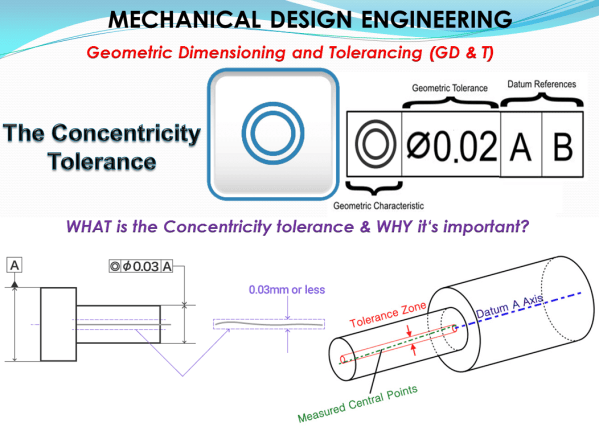
The functionality of a part in an assembly is usually well defined by the 4 form tolerances (straigthness, flatness, circularity and cylindricity) and among the orientation tolerances by the 3 most frequent ones: the position, the perpendicularity and the parallelism tolerance. Yet we have 14 different types of tolerances in total, which can be anytime... Continue Reading →
CREO PARAMETRIC 6.0 – Audi Wheel Rim Design
A wheel rim design can be done in different ways, depending on the wanted pattern and the used CAD software. In this example I show you a version of Wheel Rim used on AUDI cars and how to do it in CREO Parametric CAD software. A wheel rim can also be done in 1 piece... Continue Reading →
The Art of Coffee – How to make a good coffee?
After, Water and Tea, the 3rd one most consumed refreshment drink must be the COFFEE. At some point I am tempted to put coffee in the same position with tea as both being the 2nd most consumed drinks on the planet, but I guess Tea better deserves the 2nd place. Like Tea, making a good... Continue Reading →
THE ART OF TEA – How to make a good Tea?
I am sure most people will say, what's so much of science to make a good tea? Should not be a big deal, simply take a bag of tea or tea leafs and put it in a cup with boiled water, then add some sweetener and done. The tea is ready. Right? Well... things are... Continue Reading →
SOLIDWORKS – Bug Rover _ Part 4 – Assembly Design
As we've already seen in the previous posts, The Bug Rover is made of various components. In this post we'll put everything together in the final product. But before to create the final assembly, let's create first the Sub-Assembly called Carterpilar which will be later used as multiple instances for the final assembly. Let's start:... Continue Reading →
SOLIDWORKS – Bug Rover _ Part 3 – Carterpilar Design
In this Part of Bug Rover design work, I'll show you the 3 main components of the Carterpilar assembly. These are: The Star Gear, The Gear Cap, The Wheel and The Carterpillar. Let's start: THE STAR GEAR STEP 1 Create a new part STEP 2 On Front plane draw the following sketch and revolve it... Continue Reading →
SOLIDWORKS – Bug Rover _ Part 2 – Lever Design
In this 2nd part of design work for the Bug Rover, I'll show you the next 2 main components: The Lever and The Lever Cap. Let's start: THE LEVER STEP 1 Create new part STEP 2 Create the following 2 sketches: STEP 3 Use the previous 2 sketches to create a Project Curve STEP 4... Continue Reading →
SOLIDWORKS – Bug Rover _ Part 1 – Cabine Design
A rover design work implies a lot of details and components. In this article I want to present you a simplified version of a reover concept I did, which is inspired from the insects world. It really looks like a bug, so I name it Bug Rover. I will only put here the main bodies... Continue Reading →
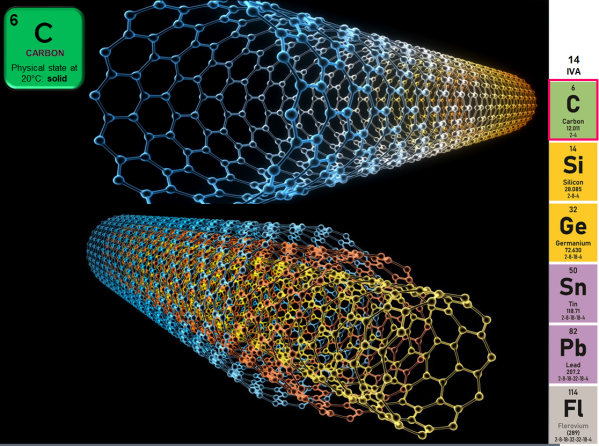
The Fascinating Chemistry of Carbon: Allotropes Explained
Carbon is a marvel of nature. This element is absolutely impressive. First of all Carbon is the main reason why life on Earth exist. And second because carbon is capable of forming the most compounds , way much more than all the other elements in Periodic Table combined. Not only that but Carbon is even... Continue Reading →
Why Carbon Nanotubes Could Power the Space Elevator Revolution
The huge success of carbon fiber composite in the second half of the 20th century, inspired engineers to imagine its use on the grandest possible scale, hence they started to ask: is this material strong enough to achieve a longstanding dream, that of building an elevator into space? A Space Elevator promises to replace the... Continue Reading →
The Importance of Helium-3 for Future Energy Solutions
Helium-3 (3He) isotope is extremely rare on Earth. Most of our supply comes indirectly from tritium (3H)decay in nuclear stockpiles, producing only modest quantities. Likewise a minor amount of 4He isotope is collected as a by-product of big companies tapping natural gas. For most people this is not a topic of much interest, so why... Continue Reading →
How Helium-3 Fusion Powers Spacecraft Generators
Helium is an inert gas, is super light, is the second most abundant element in the universe (after hydrogen), yet on Earth, Helium is scarce, is a non-renewable resource and is very expensive to produce.One of its isotopes even more rare an precious is Helium-3. If we could somehow get more Helium-3, our dream about... Continue Reading →
Can Helium-3 Fuel Revolutionize Space Travel?
Humanity has always looked up at the stars with nothing but a deep desire to travel to them. For decades we have yearned to sail with a great cosmic ocean unlocking mysteries of other worlds. But to conquer the cosmos we fist need a way to travel across it and with our space technology we... Continue Reading →
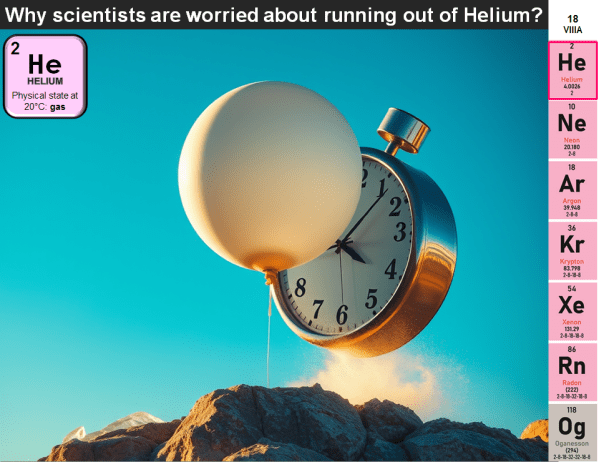
Why scientists are worried about running out of Helium?
Helium is something of a bizarre contradiction here on Earth. Although it’s the 2nd most abundant element in the universe as a whole, combining with hydrogen (the most abundant) to form an estimated 99% of all known matter that’s out there… helium is becoming increasingly rare on Earth. The main reason for that is because... Continue Reading →
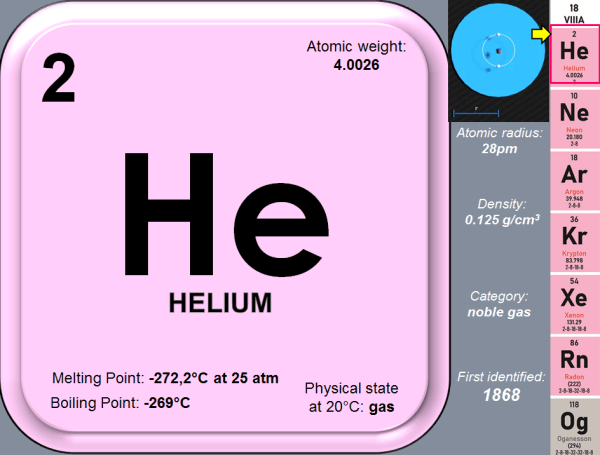
HELIUM (He)
The far right column in The Periodic Table is the group 18th of elements also known as the group of noble gases. It includes 7 elements in the following order from top to bottom as follows: Helium (He)-element 2 Neon (Ne)-element 10 Argon (Ar)-element 18 Krypton (Kr)-element 36 Xenon (Xe)-element 54 Radon (Ra)-element 86 Oganesson... Continue Reading →
EARTH – Why Are Clouds Mostly White? Understanding Their Appearance
Clouds are often a presence on the sky. We all see them from the ground, yet the best view we can get on them is always from above. Observing the clouds from above we can understand well enough that they are clearly the reason why we have different weather condition on the ground, and why... Continue Reading →
Do Airplanes Really Affect Global Warming?
At least in the last 2 decades we often see damages created after heavy rains worldwide. Extreme weather seems to make the headlines almost every week, as disasters increasingly strike out of season, break records, and hit places they never have before. Decades of scientific research has proven that human-caused climate change is making some... Continue Reading →
How Cloud Seeding Affects Rainfall and Weather Patterns.
Human life depends on rain. Rain is the source of freshwater for many cultures where rivers, lakes, or aquifers are not easily accessible. Rain makes modern life possible by providing water for agriculture, industry, hygiene, and electrical energy. Governments, groups, and individuals collect rain for personal and public use. Rain is in general a natural phenomenon and occurs on Earth regularly. Yet for rain... Continue Reading →