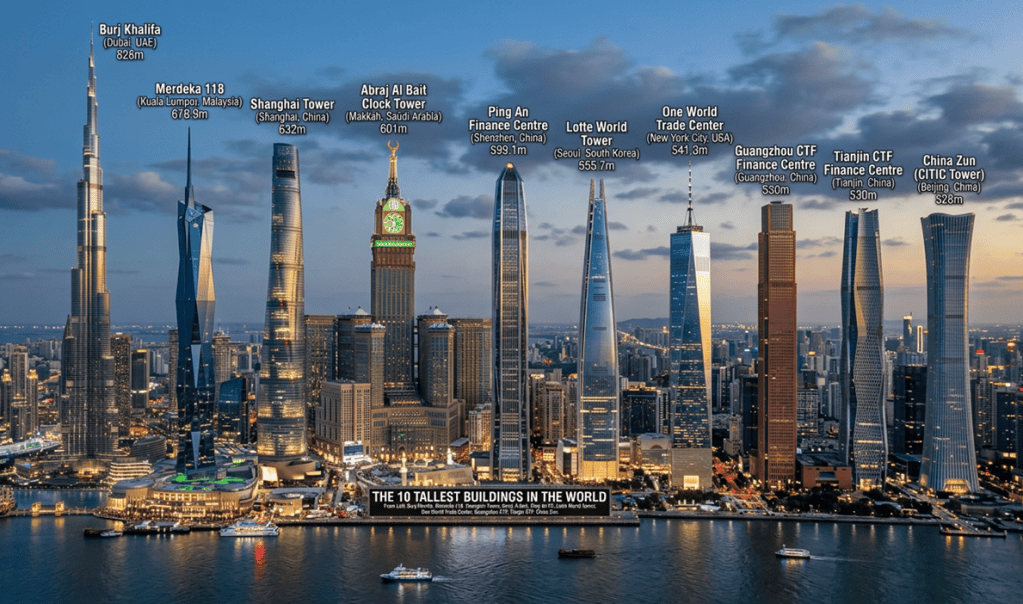
Since its discovery by mid of 19th century, Steel Reinforced Concrete has become the most multipurpose building material of all time allowing us to build large and tall building structures. Large buildings were also built long time ago during Roman Empire, but Romans used a particular volcanic ash in their cement without reinforcements and they also used a lot less lime. Those buildings were indeed large but not tall. Today we have steel reinforced concrete that allows us to build structures non only large but very tall too. With Steel reinforced concrete we can build skyscrapers. There are already many such tall buildings all around the world today. One of the most famous is the Burj Khalifa in the UAE completed in 2010 with its 828m height is currently the tallest building ever built. There are ongoing projects to go even higher. The two buildings expected to overtake it are subject to intermittent construction – the Jeddah Tower, at 1,008 metres, which was halted in 2017 and resumed in 2023; and the Dubai Creek Tower, which has experienced several interruptions. The kilometre remains the dream that architecture has been pursuing for a century, and which remains as yet unfulfilled. Meanwhile the top 10 tallest building structures is the world are the following:
- 1- Burj Khalifa, Dubai -UAE – 828 m tall (completed in 2010)
- 2- Merdeka 118, Kuala Lumpur-Mayasia, 679 m tall (completed in 2024)
- 3- Shanghai Tower, Shanghai-China – 632 m tall (completed 2015)
- 4- Makkah Royal Clock Tower, La Mecca – Saudi Arabia -, 601 m tall (completed in 2012)
- 5- Ping An Finance Center, Shenzhen -China, 599 m tall (completed in 2017)
- 6- Lotte World Tower, Seoul – South Korea – 555 m tall (completed in 2017)
- 7- One World Trade Center, New York – USA – 541 m tall (completed in 2014)
- 8- Guangzhou CTF Finance Centre, Guangzhou – China, 530 m tall (completed in 2016)
- 9- Tianjin CTF Finance Centre, Tianjin – China, 530 m tall (completed in 2019)
- 10- CITIC Tower, Beijing – China, 528 m tall (completed in 2018)
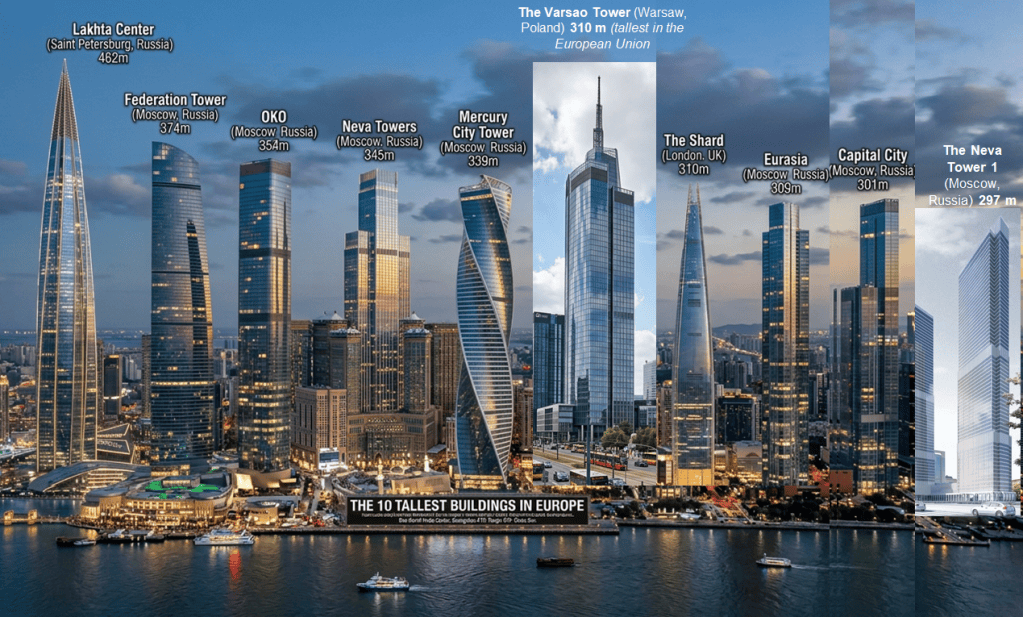
As you can see none of these are built in Europe, I keep wondering why not, but however currently few tall buildings exist in Europe as well. But only 10 of them are higher than 300m, most of these are located in Russia in Moscow and Saint Petersbourg. The list of these 10 European skyscrapers in the order of their height is this:
- 1st- Lakha Center = 462,5 m tall (The tallest building in Europe) in St. Petersbourg_Russia (completed in 2019)
- 2nd – Federation: East Tower = 373,7m tall _ Moscow_ Russia (completed in 2016)
- 3rd – OKO: South Tower = 354,2 m tall _ Moscow_Russia (completed in 2015)
- 4th – Neva Tower 2 = 345m tall _ Moscow _Russia (completed in 2019)
- 5th – Mercury City Tower = 338,8 m tall _ Moscow_ Russia (completed in 2013)
- 6th – Varso Tower = 310 m tall _ Warsaw _ Poland (completed in 2022)
- 7th – The Shard = 309,6 m tall _ London _ United Kingdom (completed in 2012)
- 8th – Eurasia = 308,9 m tall _ Moscow _Russia (completed in 2014)
- 9th – City of Capitals: Moscow Tower = 301,8 m tall_ Moscow _ Russia (completed in 2010)
- 10th – Neva Tower 1 = 297 m tall _ Moscow_ Russsia (completed in 2019)
Clearly it’s impresive to see all these. Walking on a street with such buildings makes you feel you are already live in the future where modern technology rules. However this is rather a feeling of aesthetics and comfort, but in-depth this is complex materials sciece process at work. And things with these materials are not really so stable and comfortable as it looks. Steel Reinforced Concrete is the stongest and stablest building material of all time but with one very important condition:
Once the building is complete, it must regularly maintained. If not, well… then you get what you pay for.
Without regular maintenance the concrete buildings of the 20th century are gradually starting to crumble away. Alas, it seems the initial promise of eternal stability that had kept Roman construction works standing after 2000 years does not hold up for modern reinforced concrete. This is serious matter, hence it´s important to understand reinforced concrete very well.
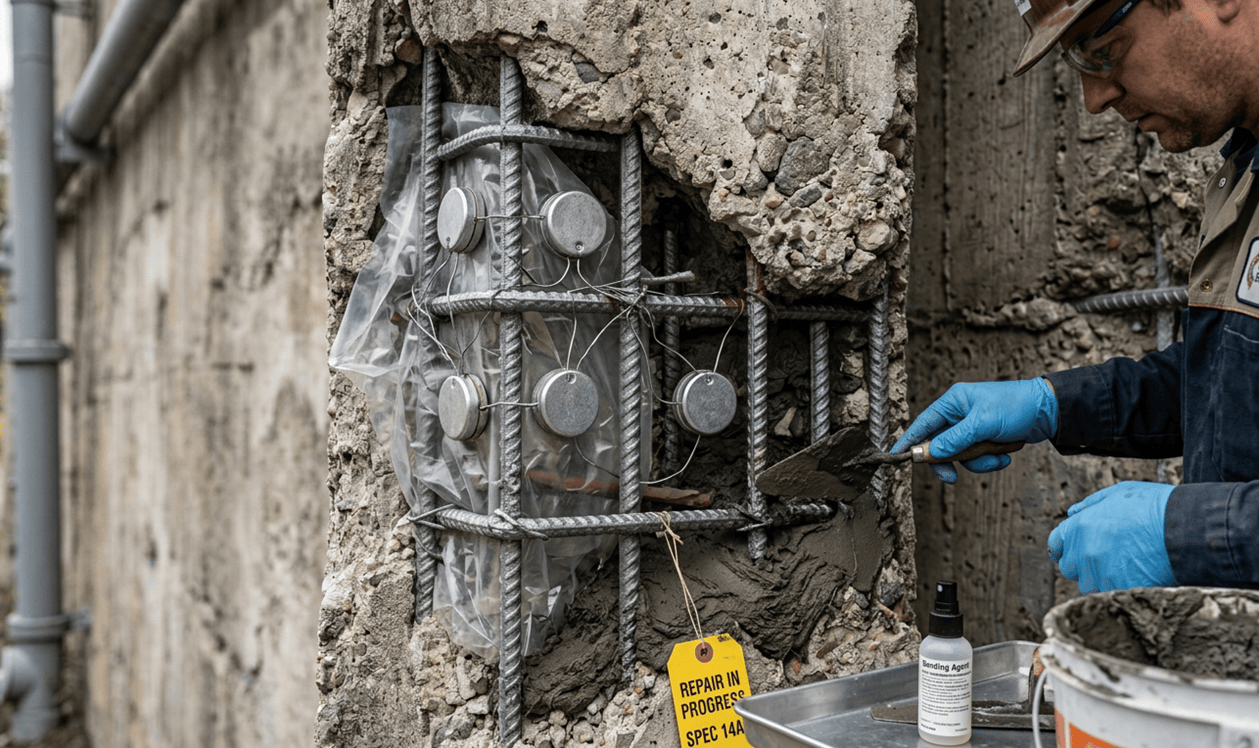
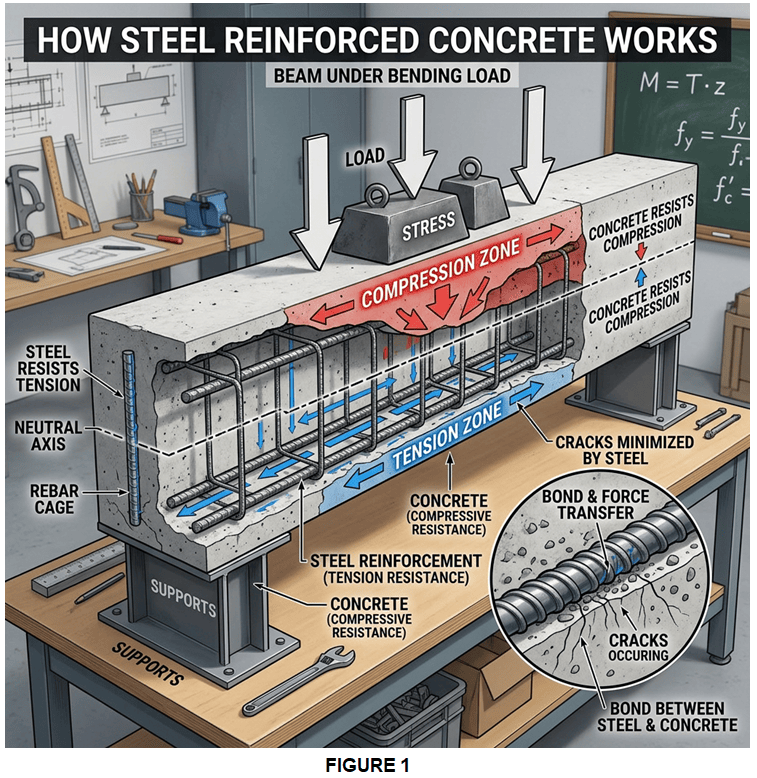
It turns out that reinforcing concrete with steel makes it strong in the short term but susceptible to concrete rot as time goes on, because iron or steel reinforcement rusts, even if it’s inside the concrete. There the corrosion grows and gradually breaks the concrete apart from within. So, unlike concrete without reinforcement, reinforced concrete needs continual maintenance. This means primarily sealing cracks and gaps to keep water and air away from the metal.Once concrete rot starts to occur, maintenance becomes much more difficult and may require partial replacement of the reinforcement. And that maintenance will exceed the cost of the building itself many times over. Do nothing, and you can expect your reinforced concrete to last 30, 40, maybe 50 years.
In the United States, virtually every piece of infrastructure containing reinforced concrete was given poor to failing marks for their current state of maintenance. Bridges came out best, scraping by with a score of 60%, while dams, irrigation works, schools, airports and wastewater facilities all failed miserably at 40% – and that’s with maintenance costs already in the billions of dollars. Expect China to start suffering from the same problems, only much worse, after 2030. Europe, too, got a wake-up call in 2018. In 1967, the Morandi Bridge in Italy, near Genoa, was one of the longest reinforced concrete bridges in the world. 51 years later, on 14 August 2018, that bridge suddenly collapsed. The cause: poor maintenance.
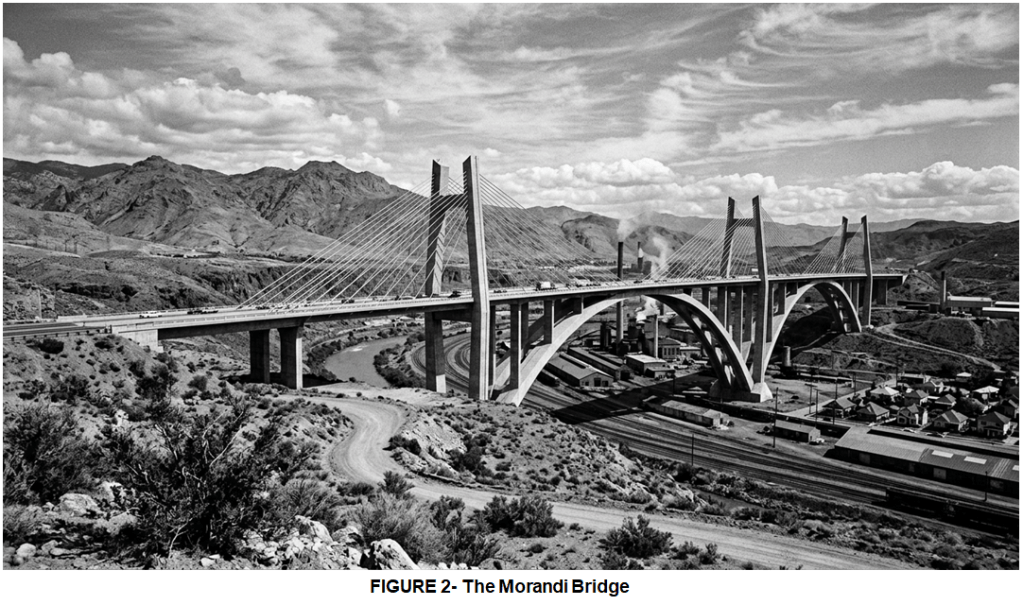
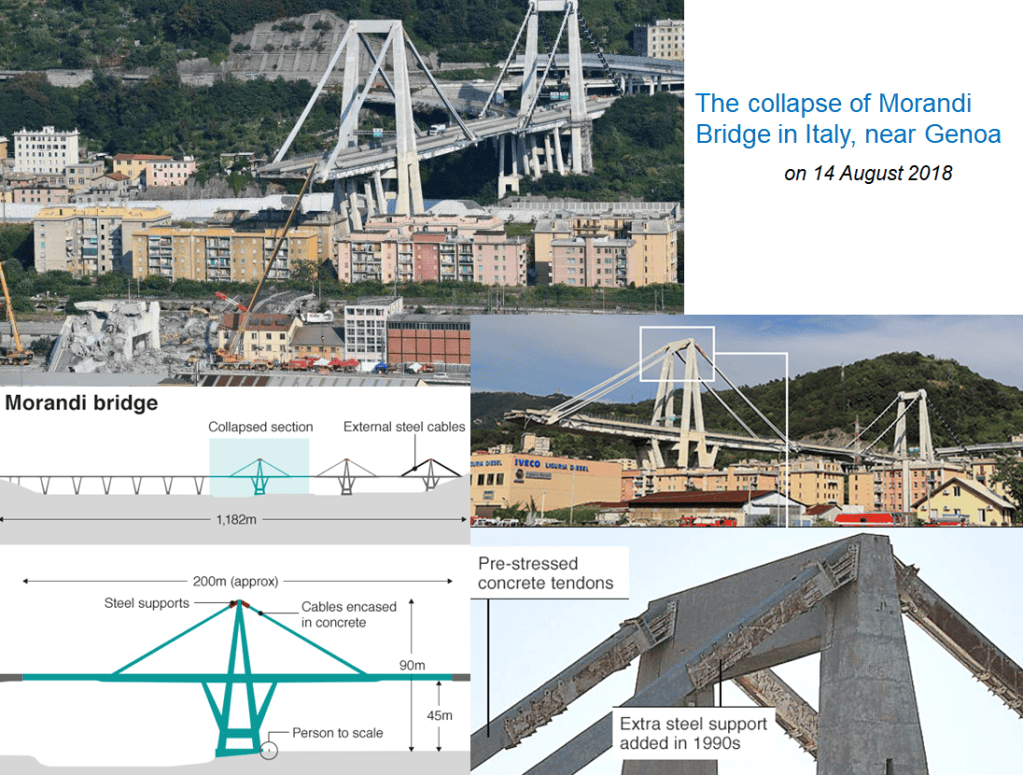
If not permanently maintained this can happen to any skyscraper as well.
To build a skyscraper requires a very complex feasability study, things really must go flawlessly. Even so, we still cannot build tall structures without considering undoing procedures sometime in the future. We simply cannot build tall structures that can stand permanently. One big isssue is that concrete reacts with water, water being one of the main ingredient the concrete is made. In spite of all these, surprisingly there are many skyscrapers built nearby water settlements, such as those in Manhattan -New York, or those in Dubai and in many places on sea shore all over the world. Clearly that’s not really the best place to build a skyscraper but they do it anyway.
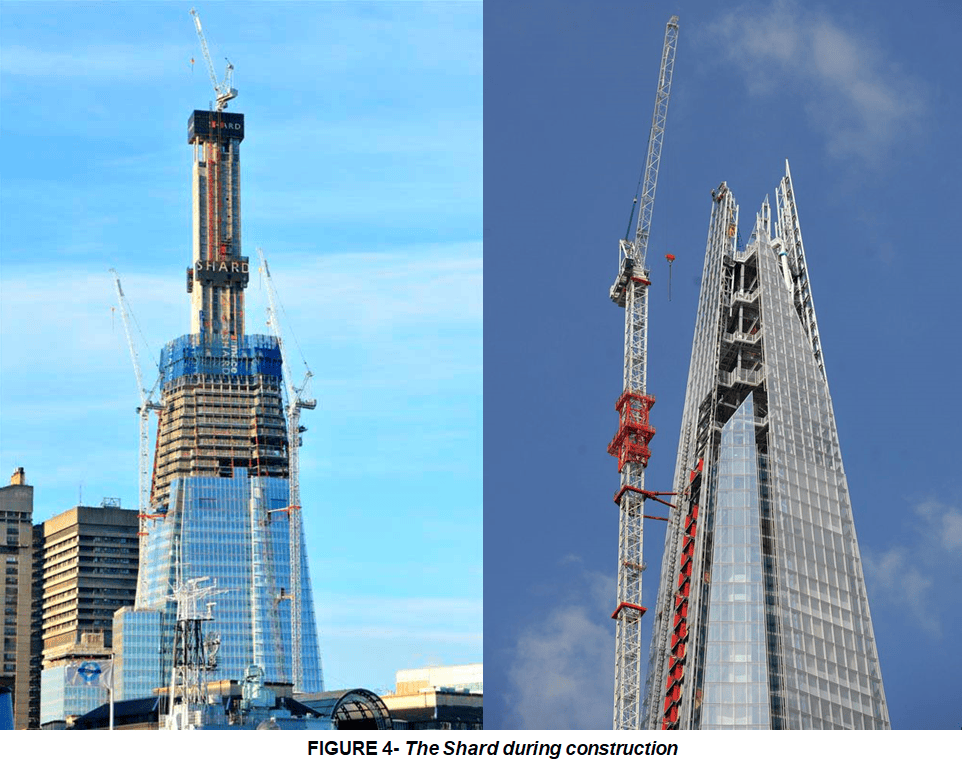
For example, when The Shard was build in London they had to consider the fact that Thames is just nearby.They had to be perfectly sure that everything will be ok to build it there. After the feasibility studies were completed, they started by digging a huge hole. And when I say huge, I mean enormous. Gigantic machines were scooping out the dirt, digging ever deeper, as if they were mining for something. But what they were digging out was clay – clay that had been deposited there for hundreds thousands of years by the Thames river.It was the same thick clay that has always been used to fire the bricks to make the houses and warehouses from which the city of London is built. But this clay was not going to be used to build the Shard. One day, once all of this clay had been removed, they poured 700 truckloads of concrete into the hole.This would make the foundations that would hold up the enormous skyscraper and prevent the 72 floors above, and the 20,000 people who would inhabit them, from sinking into the clay. They filled the enormous hole with concrete, layer after layer, building up floor after subterranean floor, until there was no gigantic hole any more, just an underground cathedral of poured concrete, which was now slowly becoming fully-solid, It was nicely done and impressively speedy, which was important because for cost reasons they had already started to build the tower before they finished its foundations.
Then, the engineers were adding approximately a whole floor every few days.What made this possible was that the concrete was being continually cast. It arrived by truck at the bottom of the building and was pumped up into a mould at the top. Meanwhile, the mould, which was the size and shape of a floor of the building, was fitted with steel rods that would become the internal skeleton of the concrete tower. Once a floor had been cast, it was then used to support the mould, which was moved up a storey ready for the next floor to be cast.And so the process was repeated; this building was growing. Growing, at a rate of 3 meters a day. What is more staggering to me, is that this boot-strapping process could seemingly continue for as long as you cared to move the mould up another floor and pour in more concrete.It is like a bud on a growing sapling of a tree. In reality, though, there are currently limits to the process.
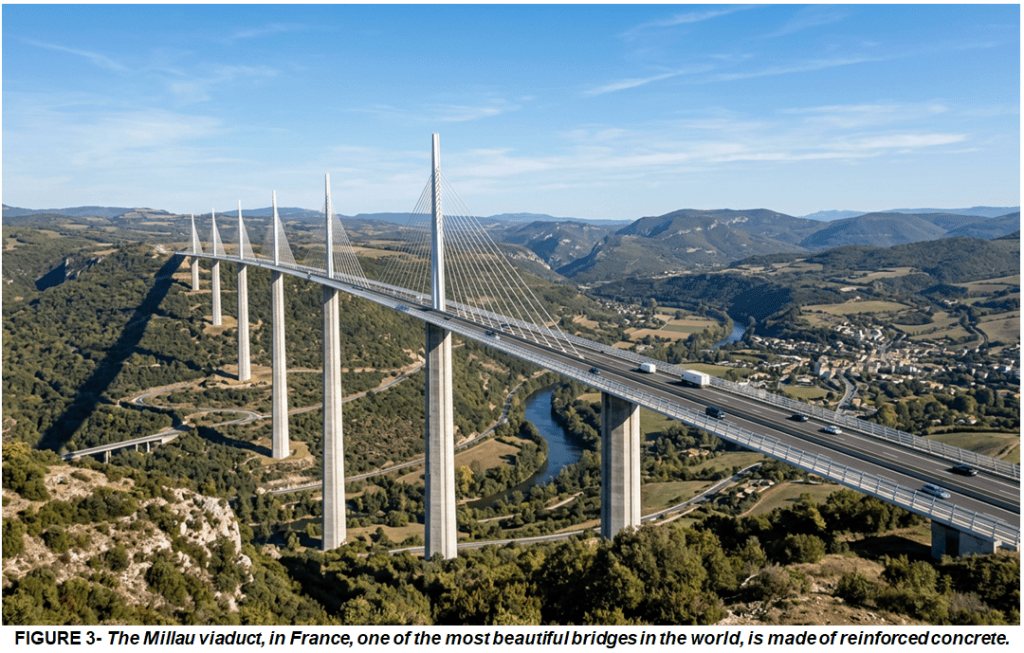
The engineers of the Burj Khalifa in Dubai, which is almost 3 times taller than the Shard, found that the capacity of the machinery to pump concrete vertically to the top of that tower proved to be a severe problem. Nevertheless, the method is ingenious. This mechanization of the process of building is what makes concrete such a modern material. It lends itself to pouring and moulding, to the rapid building of vast structures. The big structures of old, such as the stones cathedrals of Europe or the great Wall of China, took decades to build. The central core of the Shard, one of the tallest buldings in Europe, took less than 6 months. The material enables you to think big, to dream. It is the material that has allowed the ambition of civil engineers to be realized. It is from reinforced concrete that the Hoover dam is built, the Millau viaduct is built, Spaghetti Junction is built.
One day, the Shard stopped growing, and then over a matter of days the paraphernalia of the concrete mould disappeared. What was left was a concrete tower seventy-two storeys high: it was grey, raw and wrinkly like a newborn. Work began at the bottom again, while the newest concrete tower in London swayed quietly in the wind, with seemingly nothing to do but watch while human ants swarmed at its base. But it was not idle. Inside the material, the fibrils of calcium silicate hydrate were growing, meshing together and bonding with the stones and steel. The tower, in doing so, was getting stronger. Although concrete reacts with water to harden to a reasonable strength within 24 hours, the process by which this artificial rock develops its internal architecture and so its full strength takes years to develop.
Once at full strength, the concrete structure will take the weight of the 20,000 people who will be inhabiting it by day. It will take the weight of all their thousands of desks and chairs, all the furniture and computers, as well as tonnes and tonnes of water. It will do this day in, day out, without visibly deforming. The floors will remain rigid and solid. And it is capable of supporting the building’s occupants and protecting them from the elements without complaint for thousands of years. If the concrete is looked after, that is.
Because despite reinforced concrete’s impressive credentials as a building material, it does need care. In fact its vulnerability has the same origin as its strength: its internal structure. ln ordinary circumstances, exposed to the elements, the steel that is used to reinforce concrete is prone to rusting. But when that steel is encased within concrete, the alkaline conditions create a layer of iron hydroxide – Fe(OH)2 – on top of the steel, which acts as a protective skin. But during a building’s lifetime, arising from normal wear and tear and the expansion and contraction that takes place during winters and summers, small cracks will appear in the concrete. These cracks can allow water inside, water that can freeze, expanding and creating a deeper crack. This type of attrition and erosion is what all stone buildings have to put up with. It is also what mountains have to put up with, which is how they get eroded. To prevent stone or concrete structures being similarly afflicted, maintenance of their fabric needs to be carried out every 50 years or so.
But concrete can suffer from a more pernicious type of damage. This occurs when lots of water gets into concrete and starts to eat away at the steel reinforcement. The rust expands inside the structure, creating further cracking, and the whole internal steel skeleton can be compromised. It is particularly likely to happpen in the presence of salt water, which destroys the iron hydroxide protection and rusts the steel aggressively. Concrete bridges and roads in cold countries and which are regularly exposed to salt (such as is used to clear snow and ice) are vulnerable to this type of chronic deterioration. Recently London’s Hammersmith flyover was shown to be suffering from concrete decay of this kind.
Therefore, Steel-reinforced concrete requires ongoing maintenance because concrete is porous and can develop cracks that allow water, oxygen, salts, and chemicals to reach the embedded steel. Once the steel begins to corrode, it expands, creating internal pressure that causes cracking, spalling, and weakening of the structure. Maintenance typically includes:
- Inspecting for cracks, rust stains, leaks, and loose or spalled concrete
- Sealing cracks and repairing damaged areas
- Keeping drainage systems, joints, and waterproofing in good condition
- Removing chlorides and other contaminants where possible
- Applying protective coatings or corrosion-control treatments
- Monitoring heavily loaded or exposed structures over time
- Using qualified structural professionals for significant deterioration
Early maintenance is much less expensive than repairing widespread corrosion or structural damage.


Leave a Reply