For its entire existence human species always needed and will forever need 2 essential things for survival: Food and Shelter. The first humans were hunter-gatherers, their only source of food was obtained through hunting and fishing. Then humans learned that food can also be produced, so they became farmers. Sometime about 10,000 years ago, the earliest farmers put down their roots—literally and figuratively and from here slowly but for sure humans settlements started to grow. The biggest next concern humankind needed after food was how to build a shelter. The hunter-gatherers used to live in caves but after they became farmers they started to learn how to build their own shelters, they build permanent dwellings that eventually morphed into complex societies in many parts of the world. And here is how the urbanization very slowly started to grow.
Yet, the problems started to grow too. To build a solid dwelling humans had to figure out from which material they must do this. The dwelling must really serve its purpose and keep standing regardless of weather conditions; otherwise the only option would have been to go back to the caves. So indeed this was a challenge for human race. Humans indeed started to build dwellings from different materials but it took thousands of years of evolution until to really find the best material to build a solid and long lasting dwelling which happened just 2 centuries ago when the Industrial revolution took place mostly by the mid of 19th century. The magic material discovered back then was the steel reinforced concrete.
This is an incredible story, such material was discovered absolutely unexpected. But before to tell you about how that happened (I’ll do this in another article), in this article I wish to tell you a little bit about steel reiforced concrete as material.
WHAT IS STEEL REINFORCED CONCRETE?
Concrete by itself is a composite material made of:
- 60-75% sand and gravel,
- 15-20% water and
- 10-15% binding agent – the crucial ingredient holding it all together.
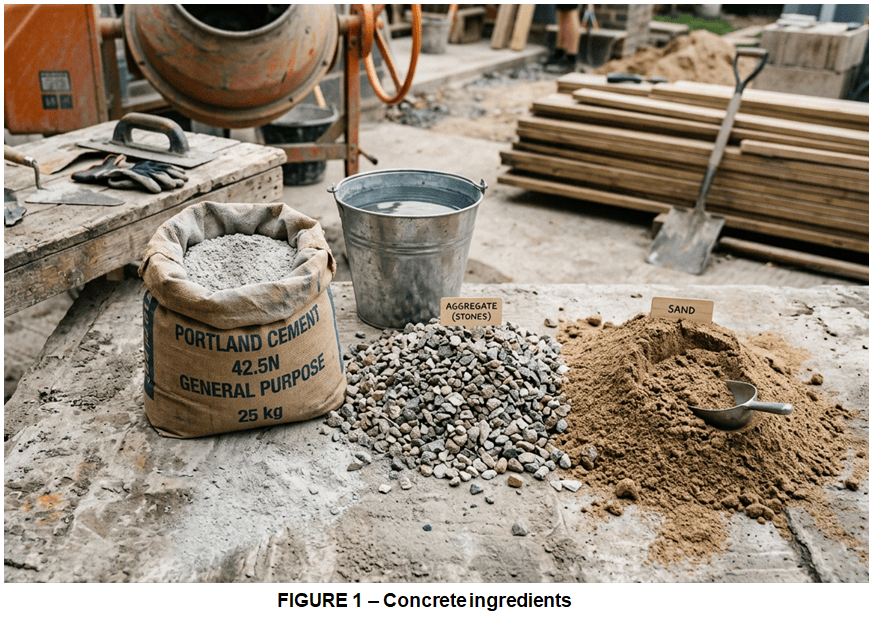
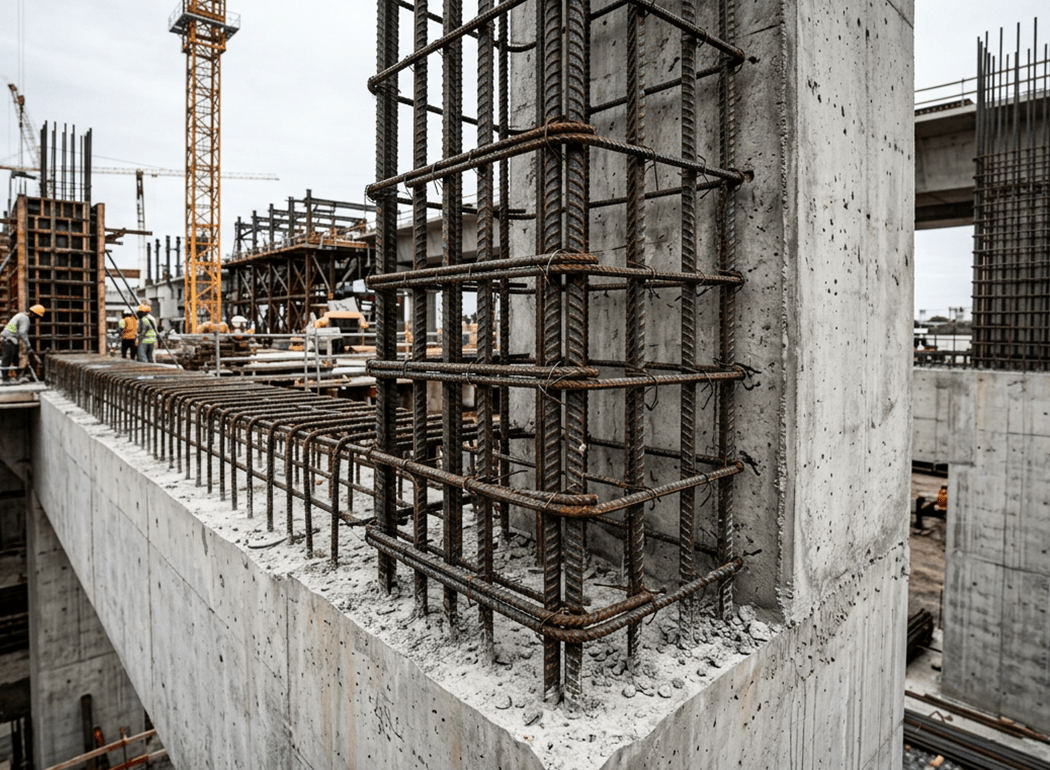
The Romans used as binding agent a volcanic ash known as pozzolana. In modern concrete, that binding agent is called “Portland cement”. Concrete has tremendous compressive strength but very low tensile strength. This makes it great for building the support pillars of a bridge, for example, but not the connecting elements between the pillars. Gravity would stress the spans to the breaking point, causing the concrete to crack. That’s why a Roman aqueduct has so many arches: they transfer the tensile forces on the span, transforming them into a compressive force on the pillars. In a modern bridge, this is unnecessary; with the addition of metal reinforcing elements (now made primarily of steel instead of iron), concrete can handle both compressive force and tensile force. ) This combination of qualities is what makes steel reinforced concrete an ideal building material.
Still, there was a healthy degree of scepticism in 1903 when the first “skyscraper”constructed from reinforced concrete – the 16-storey Ingalls Building in Cincinnati, Ohio – went up. One year earlier, the building permit application for the Ingalls had been rejected; the building inspector found the design too experimental and had concerns about the building’s safety. Many were convinced that the building wouldn’t last a day after the construction supports were removed. The story goes that one reporter even camped out during construction, watching the building the whole night through, hoping to document the moment of collapse. But it didn’t collapse. When the building was topped out and the flag ceremoniously raised on it, The Cincinnati Enquirer wrote:“It is now assured that the building is a success.” It’s still standing to this day.
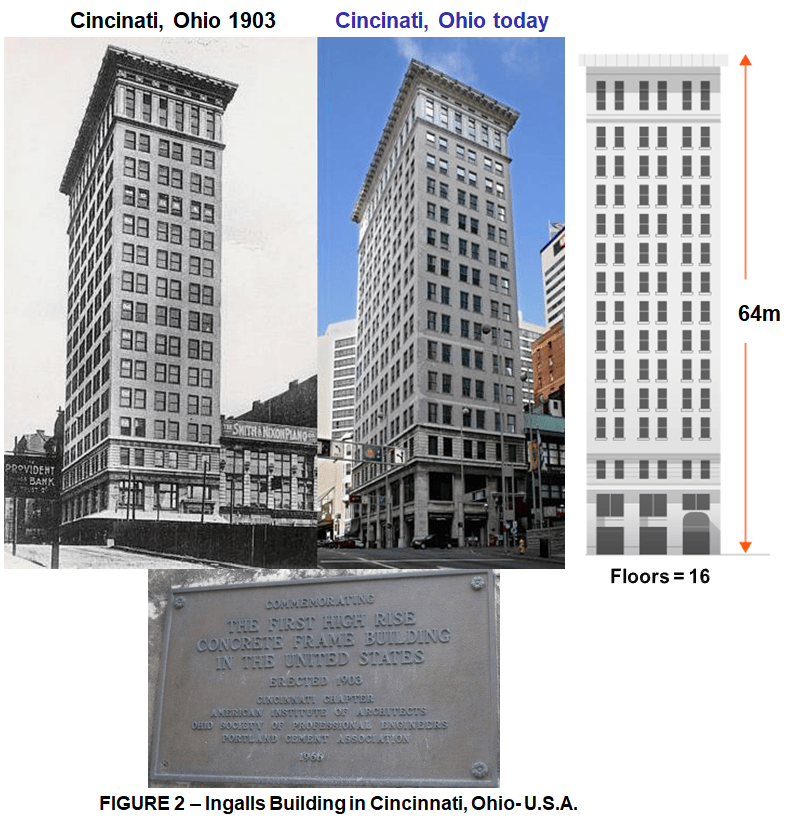
Since then the history of tall buildings has started. Mainly in the North America, a lot of such buildings started to grow to the sky. In Europe not so much, until very late, even later than the year 2000. Such buildings are only possible because of steel reinforced concrete. Due their huge mass it´s extremely important to have a stable ground beneath and very serious fesability studies must be with high accuracy done. When water is nearby the things could turn in a massive disaster, so no error allowed when the feasibly studies are done. Things really must evolve perfectly. It´s the case for any tall buildings not only for those close to water, but water can create additional issues. Most people seeing such masterpiece will surely will ask:
How long will the concrete take to dry?
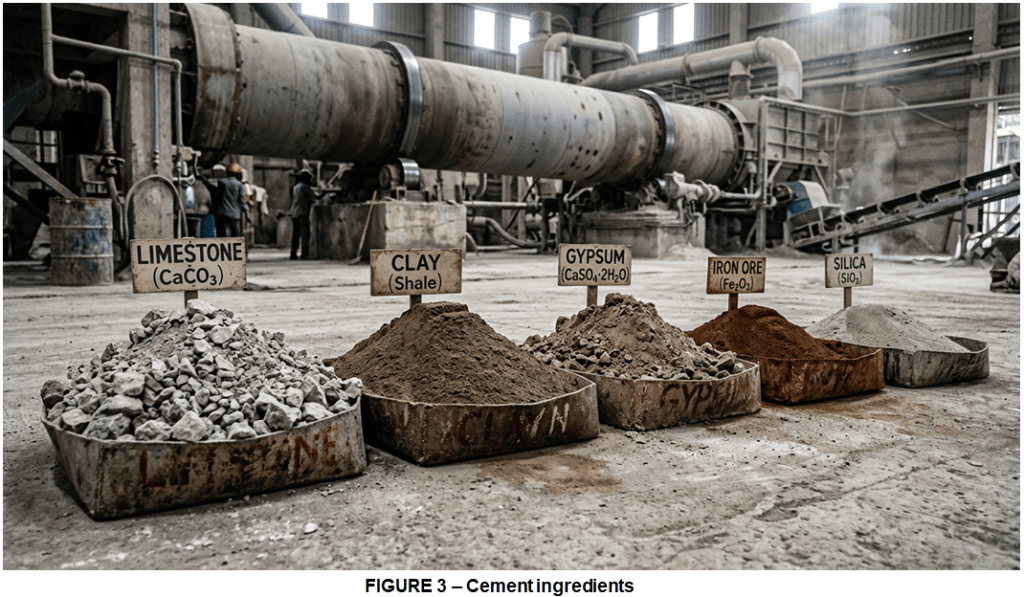
Well…concrete doesn’t dry out. Quite the opposite, as I mentioned above water is an ingredient of concrete. When concrete sets, it is reacting with the water, initiating a chain of chemical reactions to form a complex microstructure deep within the material, so that this material, despite having a lot of water locked up inside it, is not just dry but waterproof. The setting of concrete is, at its heart, an ingenious piece of chemistry, which has powdered rock as its active ingredient. Not every type of rock will work. If you want to make your own concrete you need some calcium carbonate (CaCO3), which is the main constituent of limestone, a rock formed from the compressed layers of living organisms over millions of years and then fused together by the heat and pressure of the movement of the Earth’s crust. You also need some rock containing silicate – silicate being a compound containing silicon (Si) and oxygen (O), and constituting roughly 90% of the Earth’s crust – for which some form of clay will do. Grinding these ingredients up and mixing them together with water won’t get you anywhere, unless you want to create a sludgy mud. In order to create within them the essential ingredient that will react with the water, you need to free them from their current chemical bonds.This is not easy. These bonds are extremely stable, which is why rocks do not easily dissolve or react with many things: on the contrary they last in fine climates or foul for millions of years. The trick is to heat them to an extremely high temperature of about 1450°C. This is a temperature far exceeding that of average wood or coal fire, which is between 600 and 800°C if glowing red or yellow hot. At temperatures of 1450°C a fire will glow white hot, with no tinge of red or even yellow in the flames but instead a hint of blue: it is so bright it is unnerving, and almost painful to look at.
At these temperatures, rock starts to fall apart and re-form to create a family of compounds called calcium silicates. It’s a family because there are lots of minor impurities that can change the outcome of what you get. To make concrete, aluminium (Al)– and iron (Fe)-rich rocks are the magic ingredients, but only in the correct proportions. Once it has all cooled down, the result is a very special powder the grey-white colour of the moon. If you put your hands through it you find that it has the silky texture of ash – there is something atavistic about it – but your hands soon feel dried out as if under a subtle type of attack. This is a very special material with a very dull name: cement.
If you now add water to this powder it sucks it up with ease and darkens. But instead of forming a slushy mud, which is what happens if you add water to most powdered rock, a series of chemical reactions takes place to form a gel. Gels are semi-solid and wobbly types of matter – the jelly served at children´s parties is a gel, and so too is a lot of toothpaste. It doesn’t slosh around like a liquid because it has an internal skeleton that prevents the liquid moving. In the case of jelly this is created by the gelatin. In the case of cement, the skeleton is made up of calcium silicate hydrate fibrils, which are crystal-like entities that grow from the calcium and silicate molecules, now dissolved in the water, in a way that appears almost organic (see picture below). So the gel that forms inside cement is constantly changing as the solid internal skeleton grows and further chemical reactions take place.
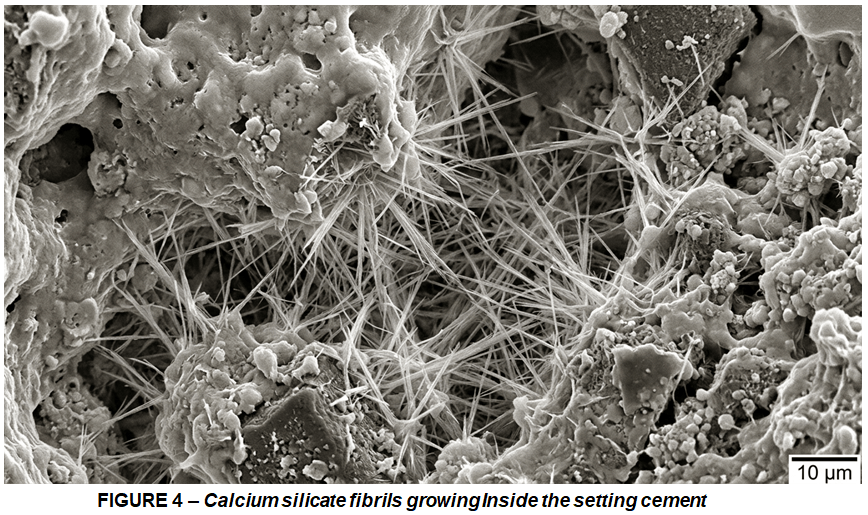
As the fibrils grow and meet, they mesh together, forming bonds and locking in more and more of the water, until the whole mass transforms from a gel to a solid rock. These fibrils will bond not only to each other but also to other rocks and stones, and this is how cement turns into concrete.
Cement is used to bond together bricks to make houses, stones to make monuments, but in both these cases it is wedged between the cracks as the minority component, an urban glue. When it is made into concrete by mixing it with small stones, which play the role of tiny bricks, it fulfills its potential to become a structural material. As with any chemical reaction, if you get the ratio of the ingredients wrong, then you get a mess. In the case of concrete, if you add too much water there won’t be enough calcium silicate (Ca₂O₄Si) from the cement powder to react with, and so water will be left over within the structure, which makes it weak. Similarly, if you add too little water there will be unreacted cement left over, which again weakens the structure. It is usually human error of this sort that proves the undoing of concrete. Such poor concrete can go undiscovered but then lead to catastrophe many years after the builders have departed. The extent of the devastation due to the 2010 earthquake in Haiti was blamed on shoddy construction and poor-quality concrete: an estimated 250,000 buildings collapsed, killing more than 300,000 people, and making a million more homeless. What is worse is that Haiti is by no means unusual. Such concrete time bombs are scattered throughout the world.
Tracking down the origin of such human errors can be tricky since, from the exterior, the concrete looks fine. For example, the supervising engineer of the building of JFK Airport in New York, noticed through routine tests that the concrete arriving on trucks before noon had good strength when it set, but that arriving just after noon was substantially weaker. Puzzled, he investigated all possible reasons for this but was unable to find the answer until he resorted to following the truck delivering the concrete on its journey to the airport. He found that around noon the driver was in the habit of taking a break for lunch and would hose the concrete with water before doing so in the belief that adding extra water would keep the concrete liquid for longer.
The composite nature of a brick building is part of its appeal. The brick itself is a unit of construction that is designed to fit in the hand, giving the whole a human scale. Concrete is fundamentally different from this building material, because it starts as a liquid. This means that buildings made from concrete can be poured, and what is created is a continuous structure, from the foundations to the roof, without any joins. The mantra of a concrete engineer is:
“You want foundations, we will pour you foundations; you want pillars, we will pour your pillars; you want a floor, we will pour you a floor; you want it twice the size? -no problem; you want it curved? – no problem.“
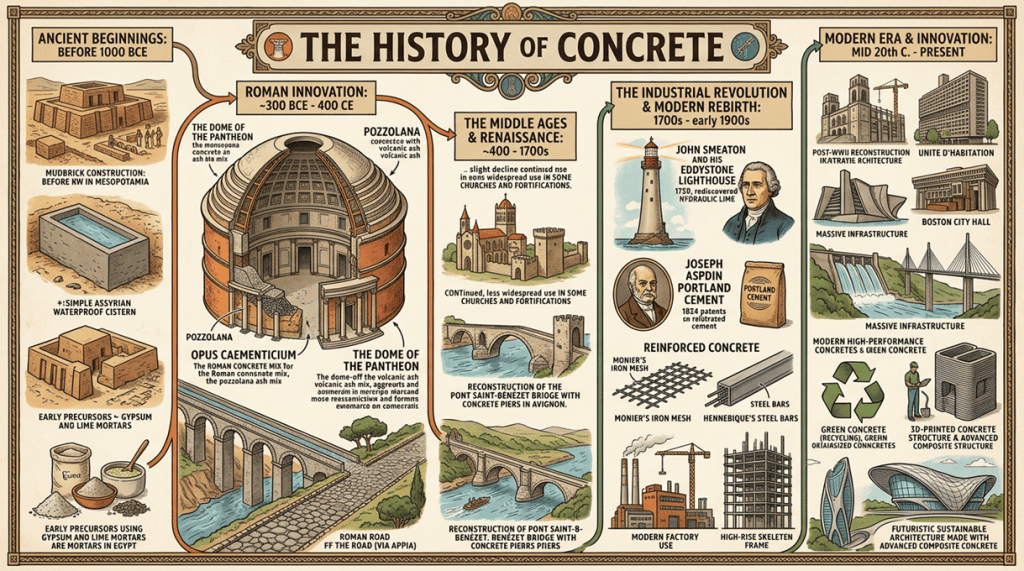
With concrete, if you can build the mould, you can create the structure. The power of the stuff is palpable, and addictive to anyone who visits the building sites where this stuff is being made. If you ever have the chance to watch and follow how skyscrapers are build you will see that how a building is growing out of the foundations; it is being poured into existence by human ants. Powdered rock and stones will ‘arrive on the site and will be transformed by the simple addition of water into rock again. It is a philosophy as much as it is an engineering technique, completing a cycle that starts when the Earth’s mantle creates rock and stone through mountain building, which is then mined by humans and transformed back into our own artificial mountains of rock, made to our own design, where we live and work.Add steel reincorcement bars and so this is why steel reinforced concrete is the most multipurpose building materials of all time.


Leave a Reply