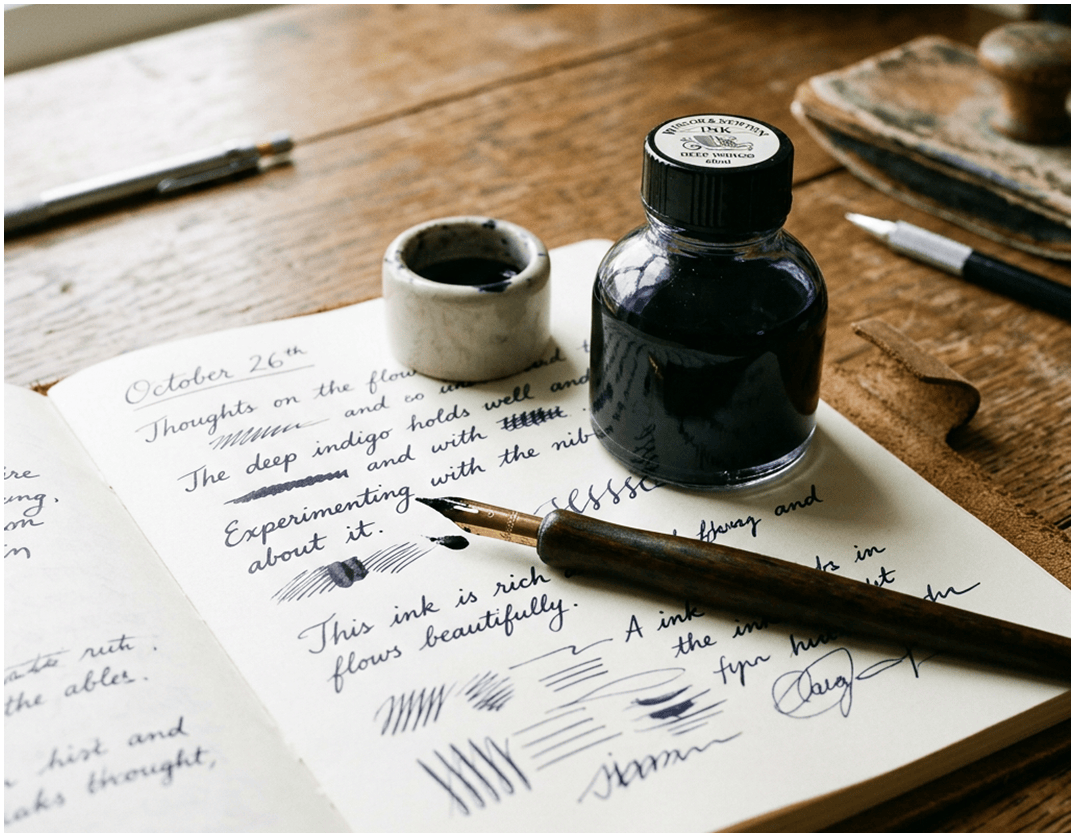
Every word you’ve ever read, every signature that changed history, every drawing and map exists because of one invisible technology = INK. It seems simple, liquid color on paper. But behind every drop is a world of chemistry and centuries of innovation. Ink is the lifeblood of our recorded history, the medium through which ideas have traveled across continents and generations. From the soot of ancient fires to the polymers in modern printers, ink’s evolution mirrors our own journey of discovery. Ink is an invention that has shaped civilization itself. Without ink, we wouldn’t have literature as we know it, modern education, newspapers, or even the ability to print money. So, what is ink truly made of? And how did it become so fundamental to civilization? Let’s uncover the hidden science behind this remarkable liquid.
WHAT IS INK MADE OF?
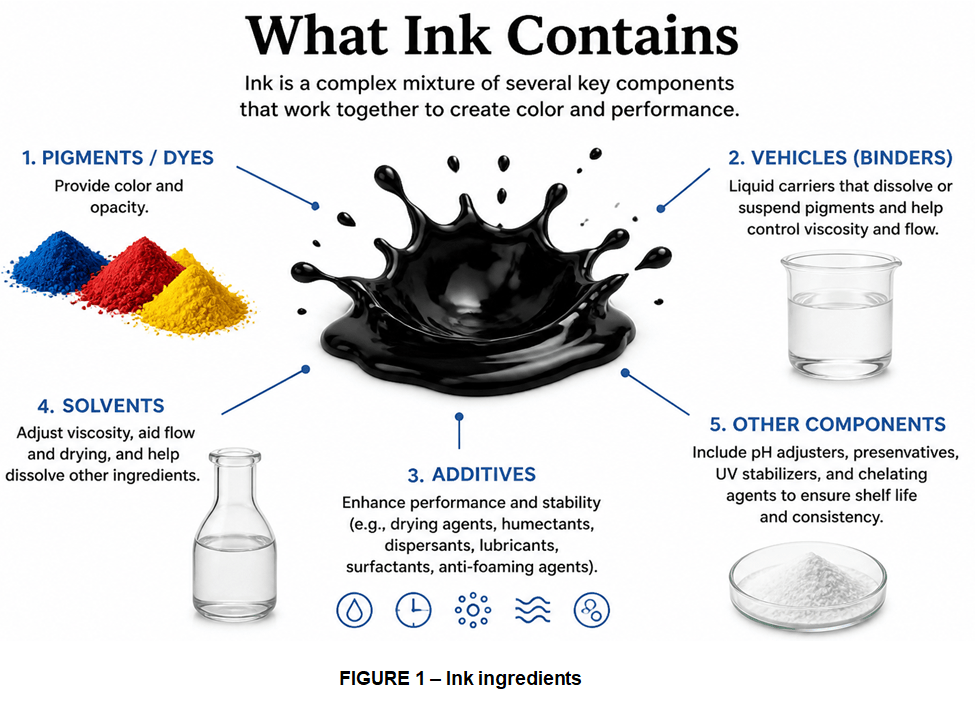
The history of human civilization is full of Ink. From Paleolithic cave paintings to parchment scrolls to printed books, ink has recorded human history for millennia. Even our modern reading device Kindle makes use of e-ink (a reusable ink that sits just below the surface of the screen), reminding its readers that ink is hardly a thing of the past. During the centuries humans used different kind of inks as a mean and method of communication – the first and longest-running form of information technology. The Ink has its origins around 4500 years ago, and was invented by both the Egyptians and the Chinese around the same time. Although historically ubiquitous and seemingly omnipresent, ink is anything but simple. Ever since the Pleistocene, inks of all types have been invented and reinvented, with every ink a product of its own unique context. On a basic material level, inks consist of 5 main components:
- COLORANT (as pigment of dye that provides color),
- CARRIER LIQUID (water, oil, alcohol or another solvent that spreads color)
- ADITIVES (substances that improve flow, drying time, gloss, durability, and shelf life)
- BINDERS (substances that help the color adhere to paper or other surfaces)
- PRESERVATIVES (or other agents to ensure shelf life and consistency)
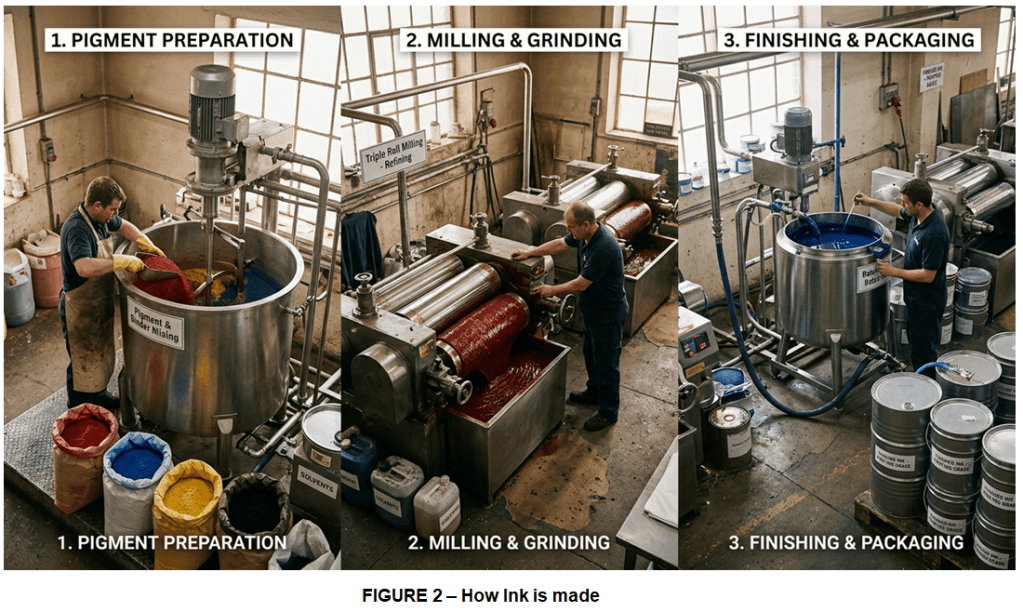
Ink Manufacturers mix these ingredients, disperse or dissolve the colorant, grind pigment particles finely, filter out impurities, and test the ink for consistency. But the way that those elements combine, and the ingredients used to make them, offer a variety of permutations, proving ink to be one of the most curious and complex substance in human history. How our ancestors made ink was actually not a very much different process versus how we make it today, it is just that today our process is both similar in principle and far more advanced in execution.
THE COLOR SCIENCE OF INK.
Let’s keep in mind that in general not all ink color is created equal. At its core, ink is a liquid that carries colorants, either dyes or pigments, and allows them to be transferred onto a surface like paper.
Hence the 1st major ingredient in modern ink is THE COLORANT, and this is what gives ink its hue. And here comes the difference, depending on which type of colorant is used, we have:
- DYE-BASED INKS or
- PIGMENTS INKS.
DYES = are soluble chemicals that dissolve in the liquid base, staining paper fibers, for vibrant, seamless color, creating bright and transparent colors. Dye-based inks are prized for their brilliance and flow. Perfect for everyday pens and markers. But dyes are vulnerable to sunlight and water, notes can fade or blur easily.
PIGMENTS = on the other hand, are tiny solid particles that remain suspended in the carrier liquid. They create more opaque and durable colors, which is why pigments are preferred for inks that need to last longer, such as those used in books, archival documents and fine art. Pigments sit on the paper surface, making pigment inks more opaque and far more resistant to light, water, and chemicals. The challenge in this case is that pigment particles must be ground ultra fine to avoid clogging pens or printer heads. Pigment inks are more complex and costly to make, but offer unmatched durability.
The chorce between Ink versions is a trade-off task. Dye-based inks are for vibrancy and flow. and Pigment Inks are for permanence and resistance. Most inks today use a careful combination of both, depending on the application. The process of making ink, therefore varies acording to intended surface on which the color must stay attached, be it papyrus, parchment, paper, wood, stone or even human skin. Hence it depends if it’s for writing, printing, marking or tattoo inks.
Black ink is often made using carbon black as colorant, a fine soot like substance that provides rich deep black tones.
Colored inks use pigments or synthetic dyes based on chemical compounds that can produce vibrant reds, blues, greens, and yellows. These pigments are ground into extremely fine particles so small that they can pass through the tiny nozzles of an inkjet printer or flow smoothly from a fountain pen without clogging. For example Phthalocyanine (H2Pc) (which is a large, aromatic macrocyclic , organic compound with the formula (C8H4N2)4H2 ) It is of theoretical or specialized interest in chemical dyes and photoelectricity) is a common chemical used to produce brilliant blue and green pigments.
Hence when you pick a pen, you’re choosing a technology of color. Fleeting brilliance or enduring legacy. Ink’s chemistry shapes not just how we write, but how our words survive. The science of color is at the heart of every mark we make. Each hue is a decision about memory and meaning. The right ink can make a moment last forever or let it fade away. Color is more than beauty. It’s the science of what endures.
The 2nd key ingredient is THE CARRIER, which is the liquid base that holds everything together. This can be any liqued that disolves pigments well enough to contol flow and viscosity, usually to most common being: water or oil.
In water-based inks, the carrier is usually just purified water mixed with solvents to help dissolve dyes or keep pigments suspended.
Oil-based inks, like those used in printing presses, use linseed oil, soybean oil, or mineral oil as the carrier.
The type of carrier determines how quickly the ink dries, how glossy it looks on the page, and how well it adheres to the surface. For example, printer ink is designed to dry quickly and bond firmly to paper fibers while pen ink is made to flow smoothly but resist smudging.
The 3rd key ingredient are THE ADDITIVES. These might sound minor, but they are crucial in fine-tuning the performance of ink. For example, resins or polymers can be added to help the ink stick to surfaces better. Surfactants reduce surface tension so the ink spreads evenly without blotching. Preservatives are used to prevent bacterial growth inside the ink bottle. In the case of ballpoint pens, lubricants are added to keep the tiny rolling ball at the tip from wearing down too fast. Each additive is carefully measured so that the final product works exactly as intended.
HOW INK IS MADE?
The actual manufacturing process of ink begins with mixing. Pigments are first ground into ultrafine powders using machines like ball mills or sandmills which crush the particles down to nanometer sizes. These powders are then dispersed into the carrier liquid under high-speed mixing. The goal is to create a smooth consistent fluid with no clumps or uneven textures. Once the pigment and carrier are thoroughly combined, additives are introduced and the mixture is carefully tested. Manufacturers check for things like color consistency, viscosity, drying time, and even how the ink smells. After passing these quality control steps, the ink is packaged into bottles, cartridges, or printing canisters and shipped to consumers.
Of course, not all inks are made the same way. Printing inks for newspapers are different from tattoo inks, which are designed to stay permanently in the skin without fading.Industrial inks used for packaging or textiles need to resist water, light, and heat. Meanwhile, high-tech inks for 3D printing or electronics must conduct electricity or create specialized patterns. This shows just how versatile ink really is. It’s not just for writing anymore, but for countless industries and innovations.
WHY INK STICKS TO PAPER?
Writing is a moment of rapid chemistry. When pen meets paper, a series of physical and chemical interactions determines if a mark is made and how long it lasts. Ink must be fluid enough to flow yet viscous enough not to feather uncontrollably. Paper is a microscopic forest of cellulose fibers. Naturally absorbent.
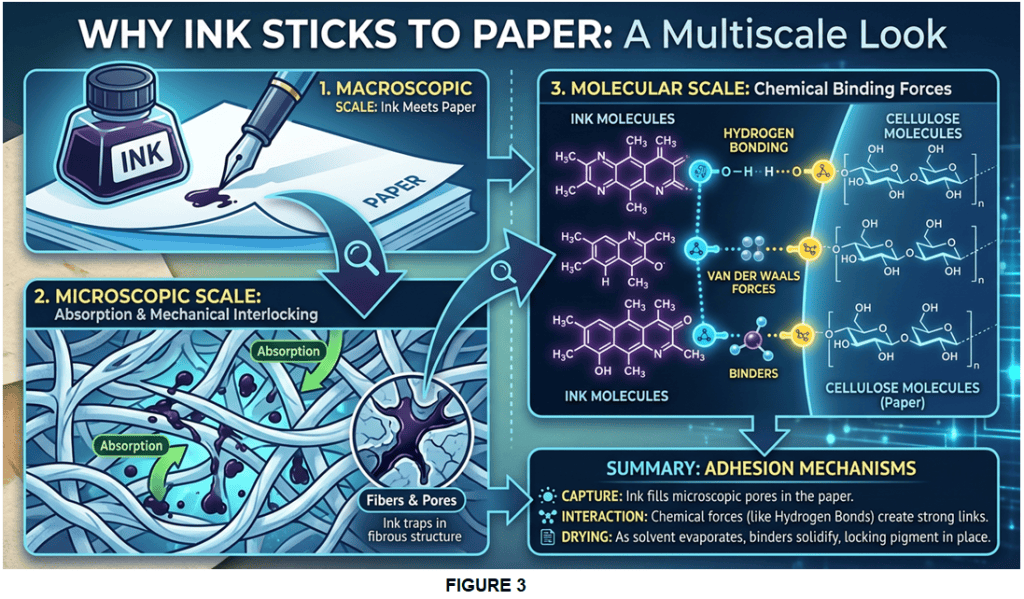
Capillary action draws ink into the tiny spaces between fibers. Adhesion makes ink stick to paper. Cohesion keeps ink molecules together. For a clean line, adhesion must win. So ink wets the paper, not beat up. Too much absorption causes feathering. Thickeners and surfactants control viscosity and spread. Once settled, ink dries by evaporation or for some inks by chemical reaction like oxidation. Modern paper is treated with sizing agents to control absorbency resulting in brighter colors and sharper lines. The quality of a written line is a duet between ink and paper. Each signature is a high-speed performance of physics and chemistry. The process is perfected over centuries, a testament to our mastery of matter. Ink’s ability to stick is the result of countless innovations, all for a simple lasting mark.


Leave a Reply