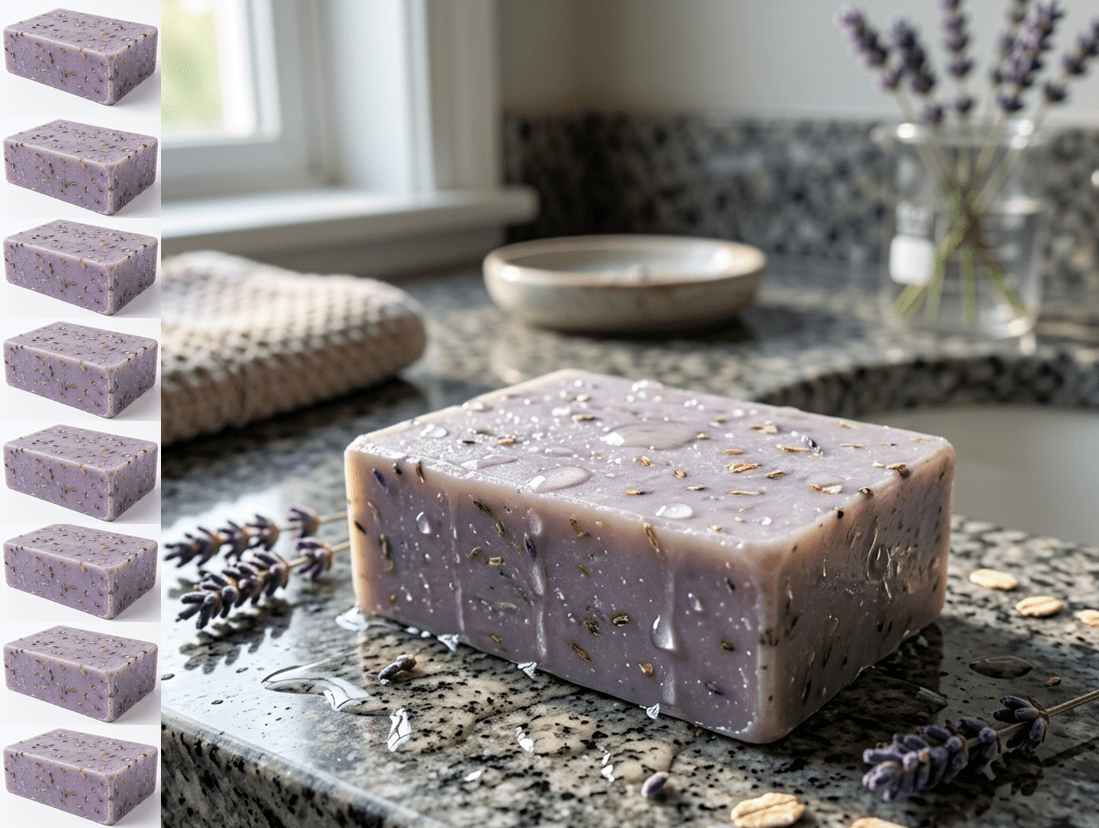
I hate dirt and the sticky substances that remain on my hands whenever I work on something. When for instance I eat a cake or I taste different sweets, after I eat in general and whenever I use the toilet, I cannot continue my day if I don’t wash my hands. The same feeling I have about dirty clothes, I just hate to feel the scum and dirt around me. Who on this planes doesn’t feel the same?, Of couse we all like to be clean and we regularly wash ourselves by default, It’s a daily habit; And it’s not only about dirt coming from the things we touch but human body itself is dirt generating machine. Our body in made of 60% water on average and that water must be regularly refreshed. Hence, like in nature there is a water cycle in human body too. We must drink water to stay healty and active. Water is the fuel that gives us energy but like any other energy transfer phenomenon not all the consumed amount translates into a 100% efficiency. Part of it becomes residual matter which represents the loss of energy. That’s exactly what happens with us too. Our body absorbs the energy potential given by the amount of water we consume and the residues are eliminated, through sweat or each time we go to the toilet. We must keep our body clean and healty and to fight and remove dirt we need SOAP.
We have various options for that: either as the form of Solid Soap and Liquid Soap. For now let’s focus on how The Solid Soap does its job.
Soap is a miraculous substance. You can wash yourself with the clearest, purest, hottest water, but you will not get rid of any of the oily grimy muck that´s caked on to your skin. For most of history, we weren´t unduly worried about this. People smelt; they were dirty. No one cared. We had bigger problems, and no sense of why soap might be important. Which isn´t to say soap didn´t exist. Recipes for making soap on ancient Mesopotamian clay tablets have been found as far back as 2200 B.C., but the material has almost certainly been around for longer than that. The process described is similar to how we make soap today:
- take ashes from a wood fire,
- dissolve them in water, and
- boil the solution with melted tallow (animal fat) – and magically you have a basic soap.
While the Mesopotamians didn´t necessarily use soap to bathe, they did use it to clean wool before weaving it into fabrics. The soap removed the lanolin, a kind of grease, from the wool fibres. But why would you use fat to remove grease?
The secret is in the ash water, the Arabic word for which is alkali, which literally means “from the ashes”. Alkalis are the opposite of acids, but both are highly reactive and can transform other molecules. In this case the alkali transforms the fats. One of the main constituents of tallow, is a molecule called a triglyceride. This has 3 tails that can be snipped off using alkali. (as shown in Fig 1 below)
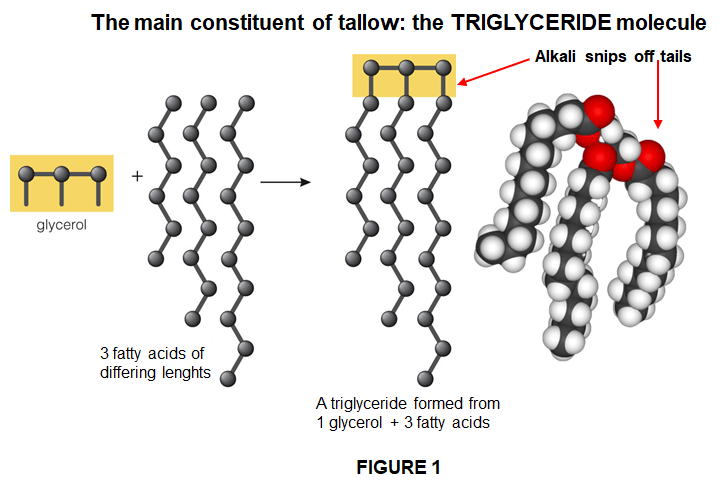
Fats, such as animal tallow, are made up of carbon molecules, with a 3-armed chemical structure of glycerides bound together at one end by oxygen atoms. The structure is completely different to water, which is much smaller H2O molecules. Water molecules are not just smaller than triglycerides, they are also polar, meaning the electric charges on the molecule are not distributed equally: there is a positive part and a negative part. This polarity is what makes water such a good solvent: it is electrically attracted to, and surrounds, other charged atoms and molecules, thus absorbing them. Water dissolves salt this way, it dissolves sugar this way, it dissolves alcohol this way. But fat and oil molecules aren´t polarized, so they can´t dissolve in water. This is why oil and water don´t mix.
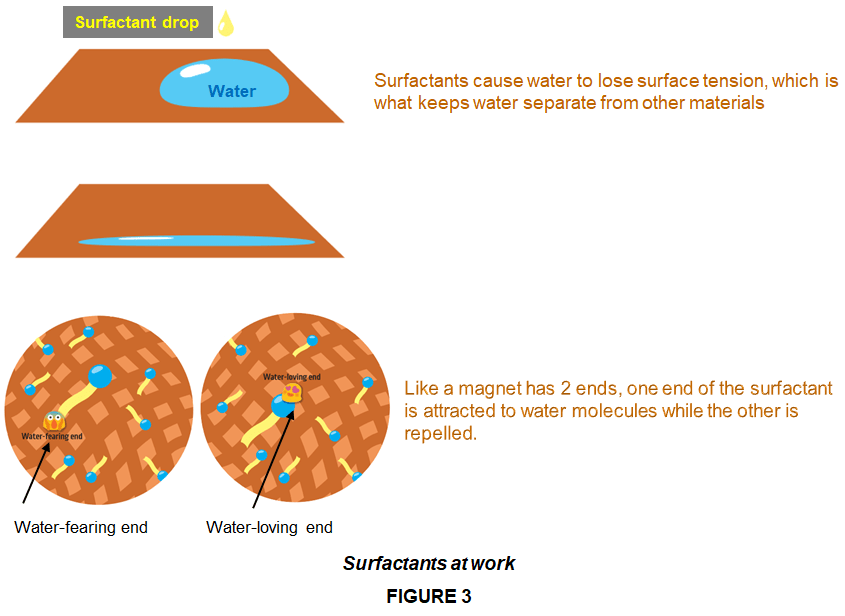
Have you ever seen a bead of water sitting on a surface? I am sure you have. You see it all the time on the widows in your house or car after the rain stops. This is because water has a property called surface tension. This tension causes water to form a bead on the surface of things like glass or fabric. You can also see surface tension at work by placing a drop of water onto a counter top. The drop will hold its shape and will not spread. In order to clean the dirt on our clothes, the water needs to be able to reach the surface. Water is able to get to the surface if surface tension is reduced. To do this, we use a group of chemicals called surface active agents, or surfactants.
WHAT IS A SURFACTANT?
Surfactants change how water behaves. When a surfactant is added, the surface tension is reduced. Now water can spread out and wet the surface (e.g., clothes, dishes, counter tops) we are trying to clean. Now let’s look at what happens on the surface.
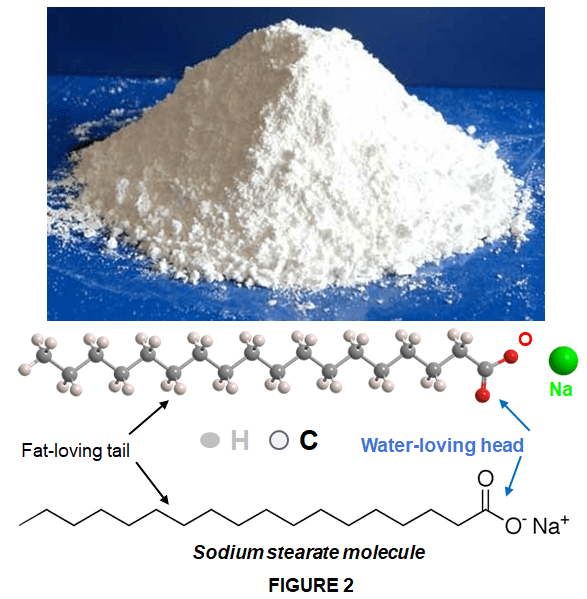
The alkali produced from wood ash splits into positive and negative components, though, so it dissolves in water. The resulting solution chemically reacts with the fat molecules, snipping off the 3 tails of the triglycerides, making them charged. This produces 3 soap molecules (called stearates). Importantly, these are hybrid molecules that have an electrically charged head, which likes to dissolve in water, and a carbon tail, which likes to dissolve in oils – it’s this hybrid nature that makes soaps so useful. The active ingredient in soap stearate, is showing its charged head, which is “water-loving”, and a carbon tail, which is “fat-loving”.
When soap molecules come into contact with a blob of oil, the carbon tail of the molecules immediately buries itself in it, thanks to their chemical similarities. But the charged head of the soap wants to get as far away from the oil as possible, so it ends up just sticking out of the blob. As more soap molecules do the same, they form a molecular structure that looks like a dandelion seed: a blob of oil surrounded by a cloud of soap molecules, with their electrically charged heads sticking out. Because the blob of oil or fat has now got a charged surface, it’s become polar, and so will dissolve happily in water. This is how soap cleans – it breaks up fat and oil residue on your hands and clothes into tiny spherical blobs, which can dissolve in water and be washed away.
HOW SOLID SOAP CLEANS?
Once the surfactant is added to water, the water-fearing ends try to stay away from the water. They do this by organizing into the shape of a sphere with the water-loving ends on the outside and the water-fearing ends protected on the inside. This spherical shape of surfactants is called a micelle.The micelle is important because it is what traps the soil. Remember, the inside of the micelle is hydrophobic and does not want to be near water. The soil is also hydrophobic, so it likes the environment the micelle creates. The attraction of the soil to the inside of the surfactant micelle helps loosen the soil from its surface. Once the soil lifts off the surface, it becomes suspended in the water in the micelle. This suspension is also known as emulsification of one liquid into another. Happy inside the micelle, the soil will not settle back onto the surface. Now that the soil is trapped in the micelle and the micelle is suspended in water, it is easy to wash the soil way. Remember the outside of our micelle loves water. So, as we rinse, the micelle floats away and we are left with a clean surface!
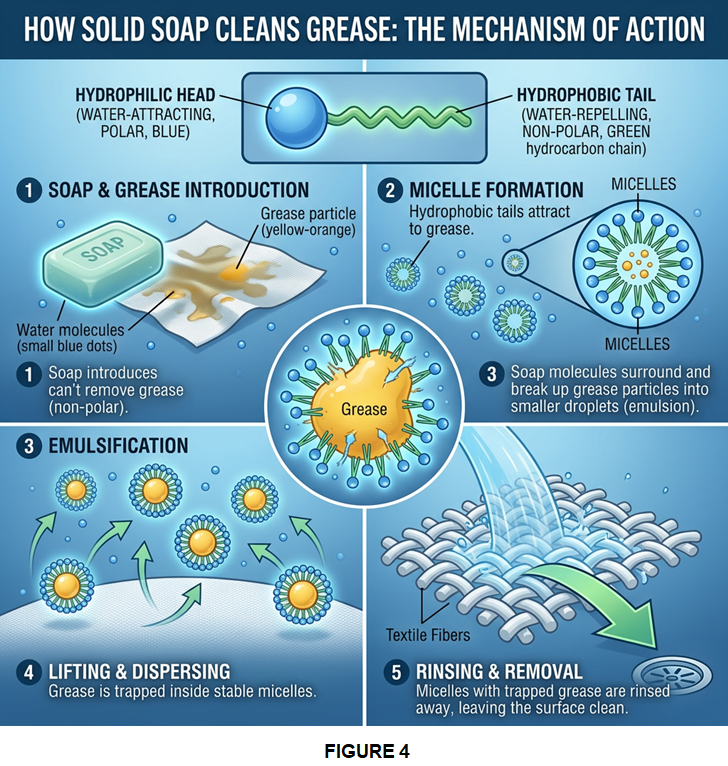
Solid Soap cleans by the action of surfactant molecules, such as stearates. The fat-loving tail of the molecule is absorbed into oil, leaving the water-loving head sticking out. The cloud of water-loving heads surrounding the oil allows it to be dissolved in the water and so cleans a surface. The clean, dry feeling you get from washing your hands with soap comes from the soap removing oils from your skin. In contrast, soap is slippery precisely because of its own fatty nature – it’s basically modified fat. That’s why it slips out of your hand so easily. It is why soaps are used as lubricants, why, if you are trying to remove a ring off a swollen finger soap can slip it right off. Using soap to clean creates a special type of liquid; it’s dirty water, yes, but it’s made up not just dirt, but also of balls of fat. In effect, it’s one liquid suspended in another – an emulsion.
WHAT ARE EMULSIONS?
These suspended liquids are very useful because they allow you to suspend many different types of liquid in water. I give you 2 most common examples:
Mayonnaise, for instance, is a very concentrated suspension of oil in water, where the ratio of oil to water is roughly 3:1. You make it by shaking the two together vigorously, until they form a cream. If you just did that, though, the liquids would separate, because, as we know, oils and water don’t mix. But if you add a soap-like molecule, it will stabilize the droplets of oil. For mayonnaise, the binding molecule comes from eggs. Egg yolks contain a substance called lecithin, which has a structure very similar to soap (with a fat-loving tail and a water-loving head), and when you add them to your oil/water mixture, they bind it all together and make mayonnaise. Egg yolk can also clean your hands, just as soap does, and there are plenty of shampoo recipes that use egg yolk as an essential cleansing ingredient.
Mustard is another substance that can emulsify oils – which is why if you add mustard to oil and vinegar, which otherwise don’t mix well, it will form a stable emulsion, also known as a vinaigrette. All these active substances work in the same way, and they all have a shared name: they’re interface molecules called surfactants.
*************************************************************
But Soap doesn’t just remove oil and fats; it also removes the bacteria that are attached to those oils and fats. Washing your hands with soap is the single most effective way to protect against bacterial infection and viruses. But despite the efficaciousness of soap as a cleaning agent, and its discovery so early in human development, the regular use of soap for cleanliness and personal hygiene is a modern phenomenon.


Leave a comment