Fire and explosions are exaclty what the Sun does. On Earth fire doesn't occur naturally that much like on the Sun, but we have it since the planet Earth exist. It is in volcanoes, in lightning strike or in wildfires ignited by the sun’s heat. Human species discovered fire so long ago that we can... Continue Reading →
Blog Feed
H – The Challenge of Hydrogen Transport
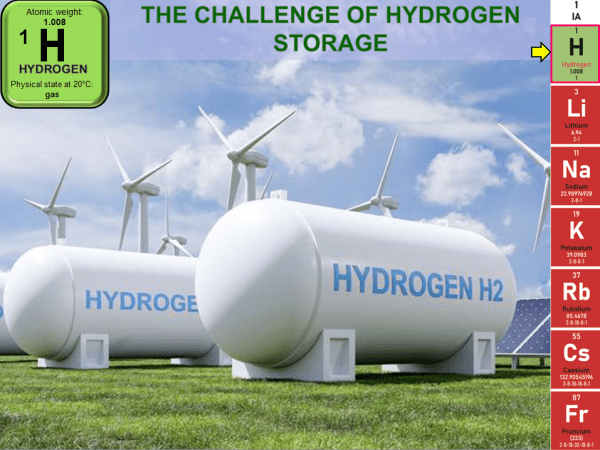
In spite of important optimisations for Hydrogen Storage in the last couple of years, containing Hydrogen remains a challenge. In order to be contained effectively and used as fuel, hydrogen needs to to be kept either as gas at atmospheric temperature under high pressure or as liquid at lower pressure but at cryogenic temperatures, or... Continue Reading →
H – The Challenge of Hydrogen Storage
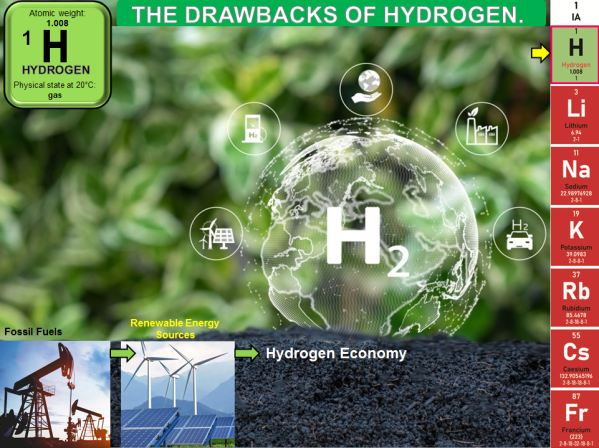
On Earth Hydrogen elemental Hydrogen is scarce. It is difficult to get and diffcult to handle. However there are plenty of sources easily available on our planet from where we can get Hydrogen. There a lot of it combined in molecules with other elements such as Oxygen (in water) and Carbon (in hydrocarbons) plus various... Continue Reading →
H – The (current) uses of Hydrogen
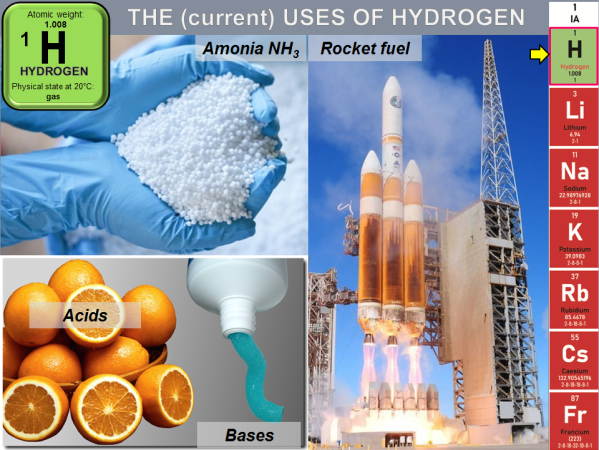
PAST USES Hydrogen gas is the lightest element of all. The prime components of air, nitrogen (N) and oxygen (O), are 14 and 16 times heavier, hence giving hydrogen a dramaticly high buoyancy. This lightness of hydrogen made it a natural choice for one of its 1st practical uses – filling hot-air balloons. No balloon... Continue Reading →
H – The Hydrogen Compounds
Hydrogen is abundant, being the most common element in the universe. The sun consumes 600 million tons of it each second. On Earth at normal temperature and pressure the element Hydrogen is a gas. Because of its atomic structure of 1 proton and 1 electron H is the lightest element in existence and has an... Continue Reading →
H – The characteristic properties of Hydrogen.
Hydrogen is the simplest, lightest and smallest possible atom in existence; it has only 1 electron and a nucleus of 1 proton. You can visualize a hydrogen atom as a dense central nucleus with a single orbiting electron, much like a single planet in orbit around the sun. Scientists prefer to describe the electron as... Continue Reading →
HYDROGEN (H)
In science simplicity and beauty are often equated and that's exactly the case for Hydrogen, which is the most compact and abundant element in existence. No doubt, Hydrogen is the numero uno, the ultimate The King of Elements. Its chemical symbol is the capital letter: H. Called in different languages its name is: Hydrogenium (in... Continue Reading →
THE 3rd STATE OF MATTER – What is a Real Gas?
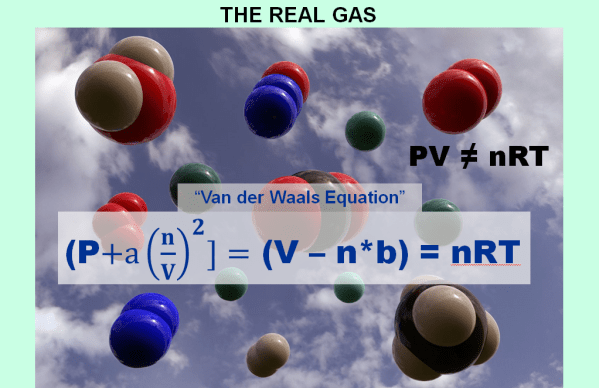
In any scientific discipline when we want to learn and understand the basic principle about how things work, we need a reference model defined in clear and simple terms so that it can be easily used and applied. When we deal with gases, the theoretical model of reference is called Ideal Gas. The Ideal Gas... Continue Reading →
THE 3rd STATE OF MATTER – What is an Ideal Gas?
Gas is the 3rd state of matter which has nor fixed shape neither a fixed volume. However gases are essential for many applications. In order to study, understand and keep a gas under control, we need to have a good study reference as starting point. And we do have that. The behavior or gases is... Continue Reading →
THE 3rd STATE OF MATTER – The 4 Laws of Ideal Gas
Gas is the state of matter with no fixed shape and volume. That means the particle in a gas aren’t particularly attached to one another being in a constant state of motion either inside of their container or as dispersed in space. However the behavior of matter in gaseous state is strongly influenced by at... Continue Reading →