Hydrogen is the simplest, lightest and smallest possible atom in existence; it has only 1 electron and a nucleus of 1 proton. You can visualize a hydrogen atom as a dense central nucleus with a single orbiting electron, much like a single planet in orbit around the sun. Scientists prefer to describe the electron as... Continue Reading →
HYDROGEN (H)
In science simplicity and beauty are often equated and that's exactly the case for Hydrogen, which is the most compact and abundant element in existence. No doubt, Hydrogen is the numero uno, the ultimate The King of Elements. Its chemical symbol is the capital letter: H. Called in different languages its name is: Hydrogenium (in... Continue Reading →
THE 3rd STATE OF MATTER – What is a Real Gas?
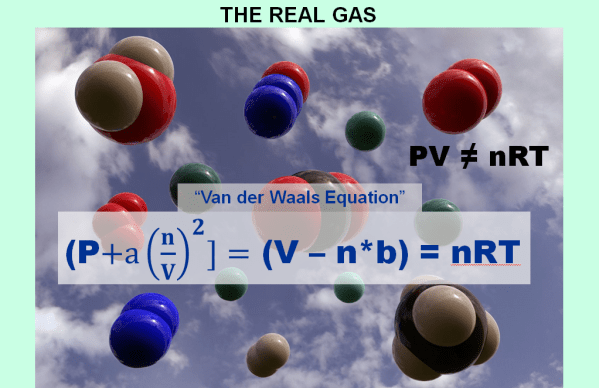
In any scientific discipline when we want to learn and understand the basic principle about how things work, we need a reference model defined in clear and simple terms so that it can be easily used and applied. When we deal with gases, the theoretical model of reference is called Ideal Gas. The Ideal Gas... Continue Reading →
THE 3rd STATE OF MATTER – What is an Ideal Gas?
Gas is the 3rd state of matter which has nor fixed shape neither a fixed volume. However gases are essential for many applications. In order to study, understand and keep a gas under control, we need to have a good study reference as starting point. And we do have that. The behavior or gases is... Continue Reading →
THE 3rd STATE OF MATTER – The 4 Laws of Ideal Gas
Gas is the state of matter with no fixed shape and volume. That means the particle in a gas aren’t particularly attached to one another being in a constant state of motion either inside of their container or as dispersed in space. However the behavior of matter in gaseous state is strongly influenced by at... Continue Reading →
THE 3rd STATE OF MATTER – GAS
Gases are all around us but most of the time we don't give them much thought. However, along with solids and liquids, gases are one of the main states of matter and the way they behave is vital for life on Earth. For example, when we breathe in, we increase the volume of our lungs,... Continue Reading →
MERCURY: On The Surface of The most Cratered planet our Solar System.
Mercury is one of the 4 terrestrial planet in our Solar System and also the one we didn't know much about until quite recently. As it is the smallest planet among the total of 8 and also being the closest to the Sun, Mercury was dificult to study. In early research, astronomers believed that Mercury... Continue Reading →
WHAT ARE THE NON-NEWTONIAN LIQUIDS?
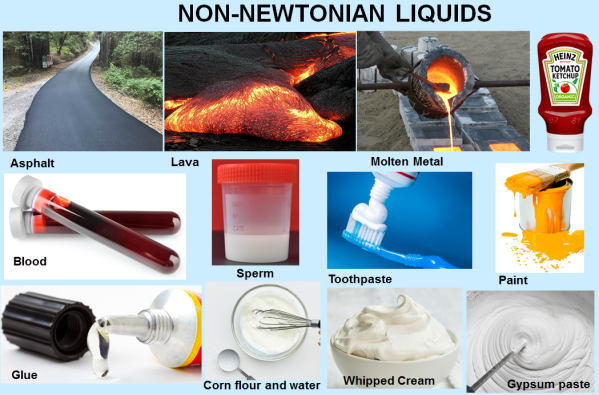
If matter is exposed to an external force such as shear stress also influenced by temperature and pressure, it tends to either have a plastic deformation or starts to flow. The volume of matter which continuously changes its shape under the influence of any force or stress, it flows and the substance is called fluid.... Continue Reading →
WHAT ARE THE NEWTONIAN LIQUIDS?
Liquid and gas are 2 different states of matter yet they have a lot in common. Both are fluid and both have free flow. In physics, the term fluid refers to any material that continuously changes its shape and form under the influence of any force or stress. The shear modulus of fluid is zero,... Continue Reading →
THE 2nd STATE OF MATTER – LIQUID
We usually use the terms liquid and fluid interchangeably in general to refer to a substance which is in a liquid state, such as water. However, there is a stark difference in both terms. In physics, the term fluid refers to any liquid, gas or other material that continuously changes its shape and form under... Continue Reading →