Chocolate is a key ingredient in many foods such as milk shakes, candy bars, cookies and cereals. It is ranked as one of the most favourite flavours in North America and Europe. Despite its popularity, most people do not know the unique origins of this popular treat.
Chocolate is a product that requires complex procedures to produce. The process involves harvesting cocoa, refining cocoa to cocoa beans, and shipping the cocoa beans to the manufacturing factory for cleaning, roasting and grinding. These cocoa beans will then be imported or exported to other countries and be transformed into different type of chocolate products.
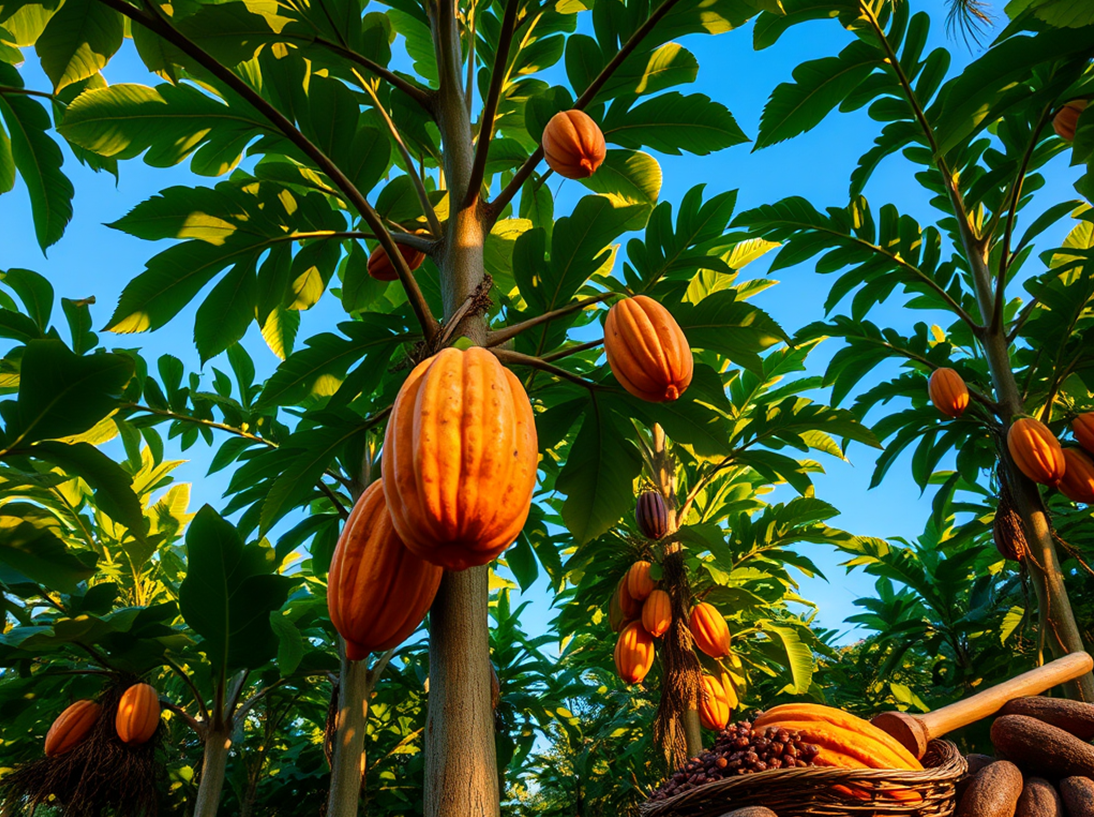
Chocolate production starts with harvesting cocoa in a forest. Cocoa trees, such as Theobroma Cocoa, grow in tropical climates, in wet lowland of Central and South America, West Africa and Southeast Asia and produce fruit in the form of large fleshy cocoa pods. These look like some form of wild and leathery orange or purple melon.
Hence no discussion of good chocolate can be complete without delving into the origin of the fruit, and its varieties. Scientists at the The International Center for Agricultural Research in the Dry Areas (ICARDA) believe that the world’s original Theobroma could be millions of years old, and the particular species we now regard as the cocoa tree could be about 10.000 to 15.000 years old.

The pods grow directly out of the trunk of the tree, not from a branch – they are about the size of a football – making them seem suspiciously unevolved and prehistoric. You can imagine dinosaurs trying to eat them (and spitting them out). Inside each pod there are 30 to 50 soft, white, fat almond-shaped seeds the size of small plums. Fresh cocoa beans are not brown at all, they do not taste at all like the sweet chocolate they will eventually produce.
The cocoa plant first appeared in the Amazon basin, and was likely domesticated by the Olmecs civilization, predating the Mayans. For the next 3000 to 5,000 years, the Mesoamerican civilizations including the Olmecs, Mayans and Aztecs cultivated and domesticated the T. Cacao plant extensively. The fermented and dried cacao beans were regarded as “food of the gods” and also used as a form of currency.
With the intervention of a few industrial processes, though, chocolate’s fortunes suddenly changed. The 1st was the screw press, invented by a Dutch chololate company called Van Houten in 1828. Crushing the fermented roasted beans with this press forced the cocoa butter to flow out and allowed Van Houten to separate it from the remaining cocoa solids. Now free of much of its fat, the cocoa could be ground down into a much finer powder and so lost its grittiness, becoming smooth, sleek and velvety. It was in this form that cocoa now became popular – and survives to this day – as drinking chocolate.
Then came a moment of counter-intuitive genius: having removed and purified the cocoa fat, and having pulverized the cocoa powder separately, why not mix them back together again, adding in some sugar, to create an ideal cocoa bean – the kind of bean you would want to pick from a tree, the kind of bean with exactly the right combination of sugar, chocolate flavour and fat that would exist in a Willy Wonka world?
There were many chocolatiers in Belgium, Holland and Switzerland who experimented with this approach, but it was an English firm called Fry and Sons who became famous for producing such nodules of “eating chocolate” and in doing so created the 1st chocolate bars. As the purified cocoa butter melted in the mouth, it released the cocoa powder, producing instant hot chocolate in the mouth – a sensation that was completely unique. Because the cocoa fat content could be controlled separately from the cocoa powder and the sugar, it was now possible to design different types of sensation in the mouth to suit different tastes. And in a time before refrigerators, the cocoa butter’s antioxidant properties meant that chocolate made in this way had a long enough shelf live to become a commercial product. The chocolate industry was born.
For some, even with the addition of 30% sugar, this form of chocolate was still too bitter, and so another ingredient was added, one that profoundly affected its taste: milk. This reduces the chocolate’s astringency quite considerably, giving the cocoa an altogether milder – and the resulting chocolate an altogether sweeter – flavour.
The Swiss were the 1st to do this in the 19th century, adding the plentiful milk powder produced by the fledging Nestlé company, which itself was transforming milk from a local fresh product with a short life into a transportable commodity with a long one. The merging of the 2 commercial products, both with a long shelf life, was an enormous hit. These days the type of milk added to chocolate varies widely throughout the world, and this is the main reason that milk chocolate tastes different from country to country.
In the U.S.A. the milk used has had some of its fat removed by enzymes, giving the chocolate a cheesy, almost rancid flavour. In the U.K. sugar is added to liquid milk and it is this solution, reduced into a concentrate that is added to the chocolate, creating a milder caramel flavour. In Europe powdered milk is still used, giving the chocolate a fresh dairy flavour with a powdery texture. These different tastes do not travel well. Despite globalization, the preferred taste of milk chocolate, once acquired, remains surprisingly regional.
One thing that all milk chocolate has in common, though, is that almost all of the milk’s water content has been removed before it is added. This is because chocolate powder is hydrophilic (water loving): given a chance it will absorb water, but in doing so it will eject its fat coating (water and fat will not dissolve in one another), in the process decomposing into a lumpy liquid, much like the Mayan chocolate. Anyone who has ever tried to add water to melted chocolate to create a sauce will have experienced this problem.
Nowadays the most diversified Chocolate supplier country globally is BELGIUM. Actually Chocolate has become the national export product in Belgium where the largest chocolate factory in the world owned by the company BARRY CALLEBAUT is located in Wieze, a small village in East Flanders region in Belgium.
Barry Callebaut factory produces around 270,000 tonnes a year, from cocoa bean to chocolate, making it the largest chocolate supplier in the world. In Wieze you will also find the first -in operation since 1988 – of the 17 Chocolate Academy centers that have since been distributed all over the world. A completely new building was opened in 2014, making the Chocolate Academy center in Wieze the largest such center in the world. The Belgian chocolate sector exports its quality chocolate to the entire world. Two-thirds of both the industrial chocolate and the end products are exported abroad. That’s because there is a Belgian chocolate code developed in 2007. The Belgian chocolate code must ensure that the term ‘Belgian chocolate’ is only used for chocolate that actually comes from Belgium.
There are 4 main varieties of the cacao plant, namely:
- Forastero,
- Criollo,
- Trinitario,
- Nacional.
Both the Criollo and Forastero variety originated in the Amazon basin. And while the Criollo is delicate and difficult to cultivate, the Forastero variety being easier and hardier made its way to Spanish, Dutch, and Portuguese colonies in west Africa, south Africa, and southeast Asia. The 1700’s brought upon a new variety of cacao beans in the Caribbean islands. Disease and disaster eradicated almost all the Criollo cocoa plants, until farmers on the islands planted Forastero to strengthen what remained. This hybrid strain is now known as Trinitario.

FORASTERO COCOA = Forastero variety still dominates in world chocolate production. The high yielding plants of Forastero made it an easy choice for growers, and even up until the mid 20th century, growers replaced the Criollo crop with the low quality Forastero for this reason. (Think of forastero as your regular grocery store tomato, and the Criollo as that heirloom tomato that creates tastes explosions in your mouth.) Forastero is primarily cultivated in West Africa and is known as bulk cocoa. This cocoa is generally earthy and simple. This pod is usually short and yellow.
CRIOLLO COCOA = Due to its fragile state, susceptibility to disease, and low production, Criollo plants now make up less than 1 to 5% (the experts vary on that number) of the total crop production in the world. Partly due to the rarity, and definitely due to its unique, complex flavor, Criollo beans are regarded as super fine cocoa and many heirloom varieties are sought after by craft chocolate makers. Within the Criollo variety, there are porcelana, chuao, ocumare beans, referencing a particular terroir of the Criollo bean. Criollo cocoa is often fruit forward, very aromatic, and has very little bitterness. When this pods are ripe they are usually long, red or yellow.
TRINITARIO COCOA = Trinitario beans while not as rare as Criollo still only make up less than 10% of the total cocoa production. This hybrid strain spread from the Caribbean islands to South America in the 19th and 20th centuries. The Trinitario being the least pure has the a wide range of tastes and profiles of any other variety. The ratios of Criollo to Forastero, and terroir greatly influence the complex flavors found in this bean. This particular one is a cross between Criollo and Forastero,the pods are either long or short,yellow or red.
NACIONAL COCOA = The least known cocoa, and fourth variety is Nacional. This bean variety was only recently rediscovered in Peru in 2011. In its purest form, it is regarded as the world’s rarest cacao. Chocolates made with Nacional beans are rich, creamy, and with little bitterness.
+++++++++++++++++++++++++++++++++++++++++++++
Here is briefly how Chocolate works:
Take a piece of dark chocolate and pop it in your mouth. For a few moments you will feel its hard corners against your palate and tongue but taste little in the way of flavour. It is almost impossible to resist the urge to give it a good bite, but very hard not to, so that you can experience what happens next: the lump becoming suddenly limp as it absorbs the heat from your tongue. As it becomes liquid, you will notice your tongue feels cooler, and then a combination of sweet and bitter flavours flood your mouth. These are followed by fruity and nutty sensations, and finally an earthy muddy taste down the back of your throat. For one blissful moment you will be in thrall to the most deliciously engineered material on Earth.
CHOCOLATE is designed to transform into a liquid as soon as it hits your mouth. This trick is the accumulation of hundreds of years of culinary and engineering effort, aimed initially at creating a popular drink that could hold its own against tea and coffee. An effort that failed miserably until chocolate manufacturers realized that making hot chocolate in the mouth instead of in a saucepan was much more delightful, much more modern and far more widely liked: in effect they created a solid drink. The chocolate industry has never looked back. What made this possible was their understanding and control of crystals – specifically, cocoa butter crystals.
 Computer Aided Design & The 118 Elements
Leave a comment