
At least in the last 2 decades we often see damages created after heavy rains worldwide. Extreme weather seems to make the headlines almost every week, as disasters increasingly strike out of season, break records, and hit places they never have before. Decades of scientific research has proven that human-caused climate change is making some disasters more dangerous and more frequent. The burning of fossil fuels like oil, gas, and coal releases carbon dioxide (CO2) into the Earth’s atmosphere, where it traps heat, warms the planet, and alters the conditions in which extreme weather forms. So we are told that this is because of us and the climate change is accelerated because we generate too much CO2, and heavy rains are the result of our actions. Sure, I agree human activities indeed have an impact on climate change. Yet I propose you to let’s take a closer look because not really every activity is included here. At least not in the way we are told it is. One of the very disputed being: the air traveling.
The narrative here is that each time a plane flies, there is a contrail of white marks on the sky and these are said to be likewise massively responsible for global warming. But is this really the case? Well… it’s definitely NOT.
DOES AIR TRAVEL HAVE ANY IMPACT ON GLOBAL WARMING?
In a way, air travel could indeed have a contribution to global warming but not in the way most of you know about it. Based on multiple studies on the topic, it appears that the impact of air travel on global warming actually remains very low. The current status is that he cumulative emissions of the air transportation sector, while generating significant societal benefits, currently contribute only approximately 2.5% of the overall global carbon dioxide (CO2) emissions (and about 1% of total radiative forcing) from human (anthropogenic) activity.
So, then what’s going on with these contrails in the sky , are they harmful for the environment?
The answer is more NO than Yes. However, indeed some contrails can contribute to global warming in a sense that being pure ice clouds that form from aircraft exhaust under specific cold conditions, they can trap heat in the atmosphere, sometimes creating as much warming as the carbon dioxide released by burning jet fuel. And some of these contrails if released in large amounts can have a contribution to warm the planet.

If you look up into the sky on a sunny day, you’ll often see contrails emanating from the back of a jet aircraft. This isn’t smoke spewing out of a badly maintained engine; it’s a kind of cloud seeded version done by the engine emissions. As opposed to the commercial Cloud Seeding method where particles of nucleating substances, such as the most commonly used Silver Iodide (AgI), are used , in case of commercial airplanes, they don’t need AgI particle to seed clouds. Instead. Small particles from the combustion process are already emitted from the plane, along with an enormous amount of very hot gas. The gas pushes the aircraft forward, and while you might expect it to be too hot for water to form, at high altitudes the temperature is so low that the exhaust is quickly cooled. The emission particles become sites of nucleation for liquid droplet formation, which then freeze, first becoming water, and then tiny ice crystals.
Depending on conditions in the air, contrails might last for just a few minutes, or maybe for a few hours and spread into cirrus-like clouds. These persistent contrails can trap heat in the atmosphere, especially at night or over dark surfaces, creating a net warming effect. and the sheer number of them (there are a hundred thousand flights per day, globally, all producing contrails) has led many to suspect that contrails must have an effect on Earth’s climate.
Common sense tells you that clouds cool our planet; if you’ve sat on the beach on a cloudy day, you’ll have experienced this. But clouds don’t just reflect sunlight back into space. They also trap heat from the ground, in the form of infrared waves, and bounce it back to Earth. It’s an effect that’s particularly noticeable in winter, when clear skies create colder conditions than cloudy skies, because at night the heat that’s lost from the ground is bounced back by clouds. And different cloud types (distinguished by color, density, and size) at different heights have different effects.
Contrail clouds (like natural cirrus ice clouds) both reflect sunlight (a cooling effect) and trap Earth’s heat (a warming effect). On average, the warming outweights the cooling particularly when contrails continue for hours and grow into wider cloud coverage. Studies estimate that the warming from these contrails is about as large as—or even larger than—the warming from aviation’s CO₂ emissions.
However Not all flights cause warming contrails; and while the aviation sector generates millions of flights each year, only a small fraction of those produce contrails that significantly affect climate. In fact, most flights have little or no contrail impact. The majority of the warming effect from contrails comes from a small percentage of flights that pass through parts of the upper atmosphere called ice supersaturated regions (ISSRs) are cold and have high humidity (water vapor). Researchers are studying ways to predict when and where these regions form, so pilots might one day be able to avoid them. Even small altitude changes may help prevent the most climate-impactful contrails.
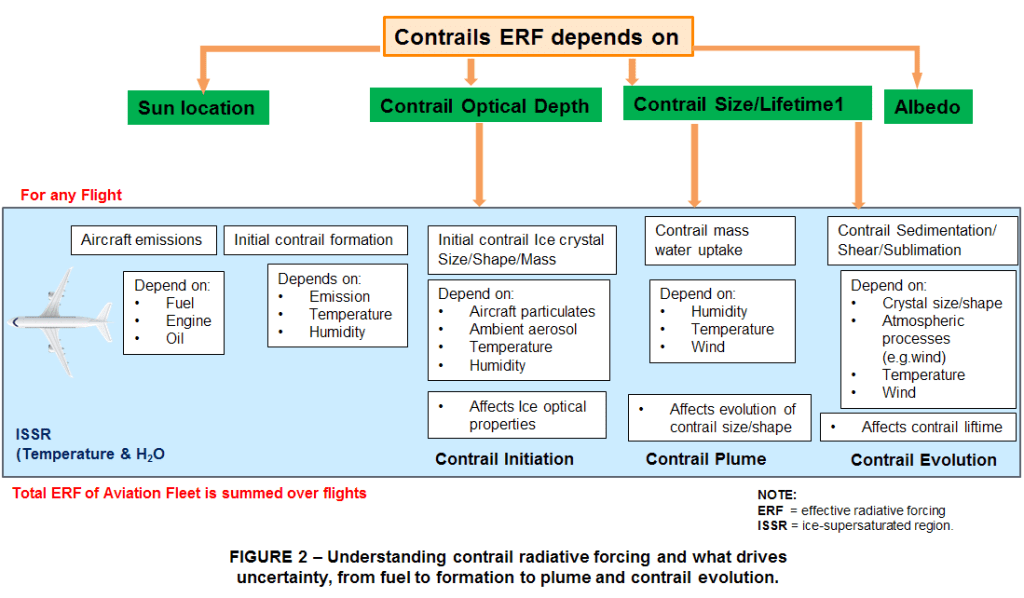
Although the warming effect of contrails is well supported, there is still uncertainty about how strong the effect is. Scientists estimate there is more than 70% uncertainty in how much warming contrails contribute, but they agree the net effect is warming. That is why better measurements of humidity and temperature at flight altitudes are a top research priority. New technologies such as improved water vapor sensors and satellite imaging could help forecast contrail conditions more accurately and support real-time contrail avoidance. All of which is to say, determining whether contrails have a net warming effect or a net cooling effect on Earth’s average temperature is an outstanding scientific question.
Investigating this question requires being able to study Earth’s climate in the absence of contrails and compare average temperatures with and without. Yet in the last 100 years, there are always aircraft flying somewhere in the stratosphere. When planes land for the night in America, they are just taking off in the Far East and Australia, and when they stop flying there, European planes take off, and so it goes —it’s a 24/7 global operation. There are more than a million people in the air at any given moment. The only time this was not true in recent memory was after the terrorist attack on the Twin Towers in New York. All planes were grounded in the United States for three days after September 11, 2001. The measurements from four thousand meteorological stations across the United States showed that on 9/11 the difference between daytime and nighttime temperatures was, on average, -16,8ºC higher than usual. This, of course, is just one study and at one time of year, autumn. It’s quite possible that in winter, spring, and summer, when cloud coverage and the localized climate would be different, the net effect of contrails would be to decrease temperatures, not increase them. There’s a lot of ongoing work in this area, but it will never be an easy matter to resolve; our climate is complex.
Certainly, it’s hard to imagine a time when we’ll be able to collect more data from a complete no fly scenario, given that flying is such an important part of global culture. The world is a connected place. It’s connected through the clouds and the rain showers they produce, and in another sense, it’s connected through airplane travel.
Nevertheless, scientists have widely discussed the possibility of controlling global temperatures through seeding clouds, and whether that would have the potential to avert some of the effects of climate change. Many suspect that they could manage solar radiation by increasing the reflectivity of the atmosphere by making clouds whiter.
The deliberate manufacture of contrails seems like an obvious way of testing that theory, and although such experiments are highly controversial, there are some who think they’re already being carried out in secret. Contrail conspiracy theorists argue that some contrails stay in the sky for too long, and that the only way that could be happening is if they’re being created by aerosols and other chemicals. Some of the conspiracy theorists go further still and argue that the contrails are evidence that governments have been spraying liquids across their territories, with the aim of psychologically manipulating the population through chemical means. These conspiracies play off legitimate fears that we could be manipulated and poisoned through the water we drink.
So until there is further solid evidence, there is nothing to worry about, contrails left behind a plane during flying at cruising altitude (on average at 12km height) have NO significant influence on global warming.
 Computer Aided Design & The 118 Elements
Leave a comment