
Until just about a century ago, except those with high interest to explore the world, regular people didn’t use to travel on long distance far away from their homes. But in the last 100 years things have changed exponentially. Today everyone has the possibility to travel the world easily. We can use various ways to travel long distances, yet by far the fastest and safest way is traveling by plane. However still there are many people who are somehow hesitant to travel by plane due to safety concerns. For example they are afraid to get on the plane assuming that on long distances the weather conditions could change during the flight and maybe heavy rain and strong lightning could occur along the way. These people still believe that flying is not that safe as we are told.
Well… compared with other means of transportation where indeed weather conditions such as thunderstorms with powerful lightnings can seriously endanger your trip, the only factor that can ruin your trip while traveling by plane is human error. That’s because technically planes are the safest traveling machines ever created, even when thunderstorm with frequent lightning occurs. Keep reading and you’ll see why is it so.
Imagine you have just taken off on your flight and are heading up through the clouds when suddenly a bolt of lightning strikes your plane and you hear a loud bang which startles people who may let out screams of fear. For sure you will hear someone in panic mode screaming “I’ve got to get out of here, I’ve got to get out of here” and then a crew member approaching an kindly saying, “Madam/Sir, try to calm down, get a hold of yourself, everything’s ok ” Yet, in moments like this it’s easy to think the worst and to think the plane may crash. It’s clearly not easy to clam down.
But what exactly happens when a lightning hits a plane?
Lightning strikes are not as dangerous as they sound. They are actually more dangerous on the ground than up in the atmosphere. Every commercial aircraft is struck by lightning approximately once per year on average, but this frequency varies depending on factors like flight routes, weather conditions and the number of flights per year. The FAA (Federal Aviation Administration) estimates that a typical commercial plane is struck by lightning once for every 1000 flight hours. However lightning strikes on airplanes are more common during climb and descent when aircraft pass through weather systems with electrically charged clouds. And only with less than 10% of strikes occurring above or below the cloud.
Hence, here is what happens = Planes flying at cruising altitude (between 10,000 to 12,000 meters) are less likely to be struck by lightning since they often fly above the majority of thunderstorms, but they can still encounter lighting near the tops of storm clouds. When an aircraft is flying through a storm cloud, the turbulent air causes the aircraft to shake and roll, to drop or rise suddenly as the pressure changes. If, in the midst of this, there’s lightning in the clouds, the plane will most likely become a part of that lightning’s conductive path; and when a plane flies through a highly charged area it can cause a disturbance in the electrical field. This disturbance may trigger a lightning strike from the cloud directed towards the plane. Yet, while lighting strikes may alarm passengers, serious accidents caused by lightning are incredibly rare. So in this case can lightning get you on a plane during the flight? = The answer is: NO.
Lightning strikes really aren’t all that unusual even though they do look dramatic for any pictures that you might have seen out there. Most pilots will tell you that they certainly experienced lightning strike during the flights but all they did notice was a quick flash, nothing dramatic and really that the airplane was completely unaffected. That’s made possible by materials science and flawless mechanical design.
The aircraft is actually designed to be struck by lightning, it’s designed so that the electricity paths will flow through the structure of the aircraft and out what we call “static wicks”. So every aircraft is equipped with static wicks normally on the trailing edges, they’re designed to dissipate the buildup of static electricity which neutrally happens through the friction of the air on the aircraft and also in a lighting strike situation they will dissipate the lightning strike energy as well. Normally they’ll do a pretty good job of it and there won’t be any issues.

Besides, as we know, many older aircraft are built from an aluminum alloy fuselage, and, as it would be in a car, the metal protects the passengers from the lightning’s charge. But the carbon fiber composites that modern passenger aircraft are made of, don’t conduct electricity at all (the epoxy glue holding the carbon fibers together is an excellent electrical insulator), so, to compensate for this, aircraft-grade carbon fiber has conductive metal fibers built into its composite structure, ensuring that when lightning strikes, it travels around the skin of the aircraft and doesn’t harm the passengers.
Likewise, if during the flight the plane you are traveling with, is struck by lightning, you will not be harmed, because the aircraft’s conductive outer shell (made of light metal alloys such as aluminum, magnesium, copper etc) acts as a Faraday Cage, directing the enormous amount of electrical current generated by lightning (often reported as millions of volts) to safely flow around the exterior of the plane and dissipate, similar to a lightning rod, and so preventing it from entering the cabin, safeguarding the passengers and crew, plus critical engine systems and electronic controls are shielded to protect them from electrical surges and have multiple back-ups and redundancies. So even if one system is disrupted others can maintain engine operation.
Just for a general definition a Faraday Cage is an enclosure made of a conducting material, such as a metal mesh, that blocks external electromagnetic fields by distributing them over the cage’s exterior. Named after British scientist Michael Faraday who first demonstrated the concept in 1836, such cage shields its interior from static and non-static electric fields, protecting electronic devices from events like lightning strikes or ElectroMagnetic Pulses (EMPs). Planes and cars are both fitting examples of Faraday cages which keep you safe when lightning strikes.
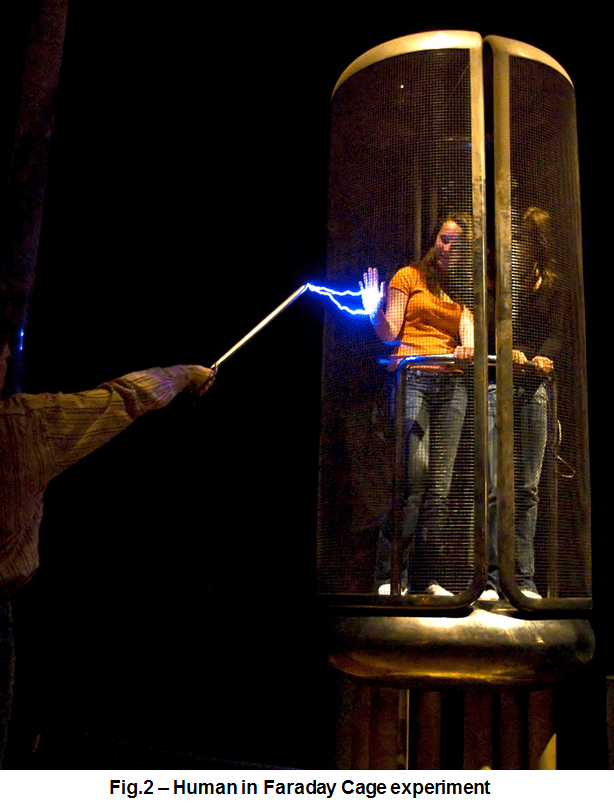
So while the lightning strike can cause a bright flash and loud bang, passengers are protected by the airplane’s design, which ensures the electricity does not penetrate the interior or harm the people inside. Most lightning strikes cause only minor cosmetic damage like burn marks at the entry or exit points. Typically entering through the nose or wing tips and exiting through the tail or another extremity and rarely lead to major system failures or engine damage. In modern aircraft. the fuel tanks and electrical wiring in the aircraft are also protected from lightning strikes.
Aircraft parts such as wings tips, nose, tail and fuselage are tested in high voltage laboratories. These labs simulate the electrical energy of a lightning strike to test how well the materials and components can handle being struck. Researches observe how the lightning travels across the surface and verify that the energy safely disperses without damaging critical parts. But even though planes are designed to withstand a lighting strike they are also fitted as I’ve already mentioned earlier with static discharges or static wicks. You will find metal strips on the nose of airplanes and small rods on the wings and wing tips, their primary purpose being to dissipate static electricity that build up on the aircraft during flight due to friction with the air.
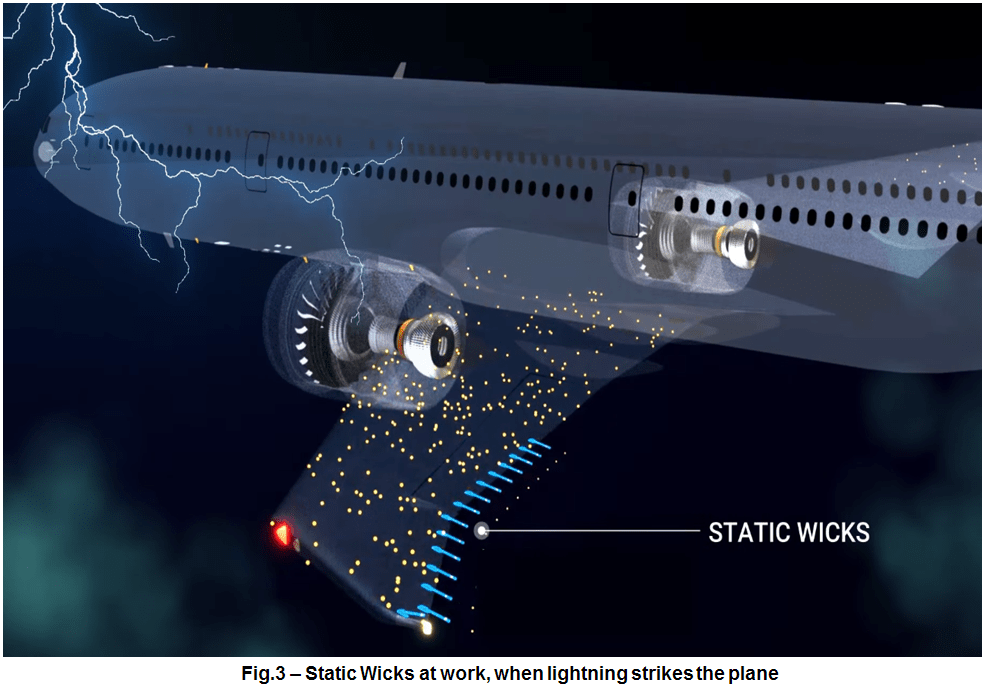
In extremely rare cases lightning could disrupt the air flow through the engine causing a temporary flame out which is the loss of combustion. Modern engines however have automatic restart mechanisms to recover quickly if this happens. Even if the level of energy of lightning strikes is high, their effects on an aircraft are limited.
While most aircraft can function normally after being struck, pilots may sometimes choose to make an emergency landing if displays or systems have been affected by the strike. The thunderstorms themselves can also produce severe turbulence, wind shear and gusts, low clouds and reduced visibility, all of which can cause delays or flight cancellations. To help minimize the risks and improve flight safety, pilots often use an advanced Lightning Tracker Tool or that provides a real-time storm data, enabling airlines to anticipate and avoid high-risk areas before takeoff and during flight. Certain weather radars are also equipped with a lightning prediction function that provides additional indications to the flight crew of areas within a storm where an aircraft may be more prone to lightning strikes.
So while aircraft get struck fairly frequently—once a year on average—there haven’t been any recorded accidents on planes as a result of lightning strikes in over 50 years. The last significant accident attributed to lightning occurred in 1967 when lightning ignited fuel vapors in a plane causing it to crash, however aircraft design standards have since improved dramatically and modern planes are now to safely handle lightning strikes.
So in conclusion while a lighting strike can be alarming to the passengers most planes experience no lasting damage due to modern design features shielding and redundant systems and serious engine failure due to lightning is extremely rare. In other words, it’s more dangerous to be on the ground, under a tree, during a lightning storm than in an airplane flying at altitude.
 Computer Aided Design & The 118 Elements
Leave a comment