Pure alcohol is a toxic stuff. Actually any drink containing alcohol if consumed regularly does not do anything good for your body. No matter what type of alcohol you drink — be it wine, beer, or liquor — it contains ethanol. When your body breaks down ethanol, it produces a carcinogen called acetaldehyde that damages DNA with other words causes cancer, so Alcohol is exactly this: a poison.
However, the good part is that is you know your limits, occasionally consumption of alcoholic drinks might actually do really good for your health. Like for example: The Wine.
One of the key flavor components of wine is its astringency: the feeling of dry, parched roughness in the mouth.
Pomegranate, pickles and unripe fruit are all astringent foods. In wines, the astringency comes from tannins.Theses molecules, which originate in grape skins, break down the lubricating proteins in saliva, and leave you with a dry mouth. But still, mild astringency in drinks is pleasurable, especially when you´re drinking them with fatty foods. Fats lubricate the mouth, but while they can make a dish feel rich and luxurious, in excess they mask flavor and coat your mouth in clagginess and sickly oiliness. Astringent counteracts this fatty feeling, cleaning the mouth, removing any aftertaste from the food, and resetting your palate to a neutral state.
Studies show that palate-cleansing works best when an astringent drink is sipped in-between bites of fatty foods; the pairing keeps the dry-mouth feeling associated with high tannins from building up, just as it makes sense to drink a red wine with steak, or a fatty fish, such as salmon, no matter what anyone says about drinking red wines with fish. People think red wine will overwhelm the delicate taste of the fish, which is why they advise white. But, in fact white wines have overlapping flavor profiles (fruity, vanilla, etc.) with red wines and so the blanket rule is not helpful. Really it´s much more important to consider a wine´s acidity and sweetness as you choose one to accompany your meal.
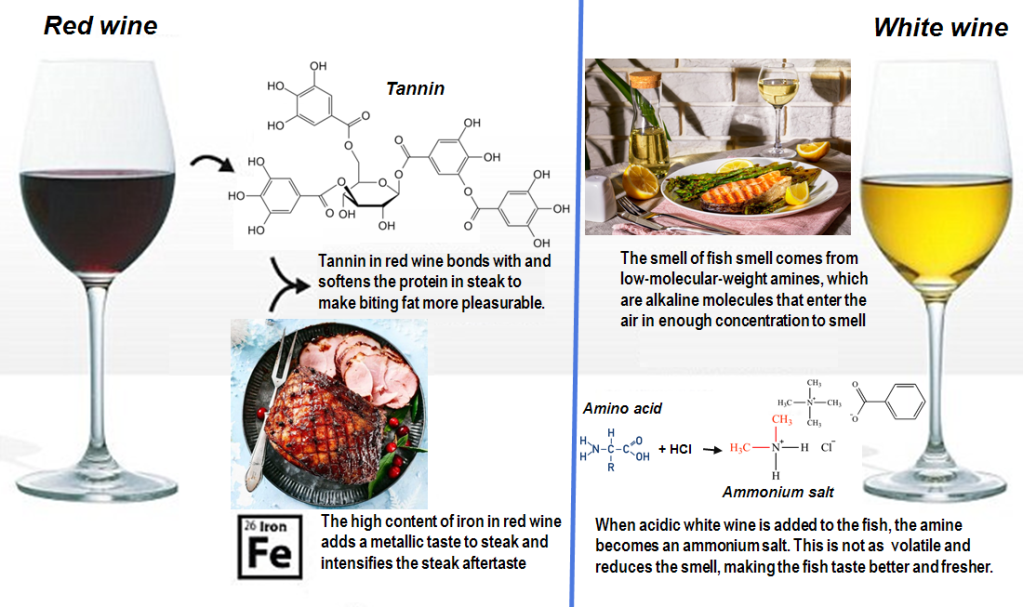
Acidity is a measure of the sourness of the drink, while sweetness is a measure of its dryness in the mouth. Some people, for instance, prefer wines that balance the bitterness of food, so they´d want to pair their meal with a glass of something dry and acidic. For instance, a full-flavoured white Rioja goes well with a Mediterranean fish stew, while red Pinot Noir works very well with glazed ham.
In many cultures, food isn’t paired with wine, but with spirits like vodka. Spirits are very effective palate cleansers because they contain a high percentage of ethanol, often 40%, which provides astringency. The alcohol also dissolves oils and fats in the mouth, along with their associated tastes. The advantage of drinking pure spirits with food is that they have very little flavor and so will not clash with a strongly flavoured dish such as pickled herring.The reason pure vodkas have so little flavor is because they have very little smell.
Although the basic tastes of salty, sweet, sour, umami and bitterness are detected by taste buds in your mouth, the complex flavor profiles of food and drinks are detected by the thousands of olfactory receptors in your nose. Hence the importance of the bouquet of wine – this is why wine enthusiasts always smell before drinking; most of the flavor you taste really comes from the wine´s scent. It is also why wine glasses are designed to have a large bowl. This is a vessel designed to hold the bouquet of the wine for your delight and appreciation.
When you eat, the release of smells inside your mouth accounts for most of the food´s flavor, which is why, when you have a cold, and mucus is covering your smell receptors, you can´t taste the subtleties of whatever dish you´re consuming. It also explains why wine tastes different at different temperatures: when it´s served cold, only the very volatile substances evaporate in your mouth, and so you experience the flavor profile dominated by those; but when you warm the wine up, the smell is different. The extra energy allows more of the flavor molecules in the liquid to evaporate. This changes the aroma of the wine and so its taste.
One of the main reasons why red and white wine are perceived to taste so very different from each other is that they are served at different temperatures. Cool down both a red and white wine, and then drink them in a blind taste test and you´ll see what I mean.
At cooler temperatures many of the fruitier flavor molecules stay in the liquid rather than contributing to the bouquet. This changes the balance of the flavor, so that acidity and dryness are emphasized, and for many this gives the experience of crispness and clarity. When combined with the cooling effect on the palate, this can be an extremely delightful experience – a classic white wine experience. Serve the same wine at room temperature and it tastes completely different. Now the acidity is muted by a fruity, passionate embrace that´s not crisp, but rather warm. There is no right or wrong here – it is just a matter of what you enjoy.
For instance in one of my trips by plane from Brussels to New York, when the flight attendant serving drinks on the plane asked me what would I like to drink I asked for red wine. The red wine I was drinking on the plane was probably at about 22°C; it being a small bottle, which I had recently poured into the glass, it had had time to adjust to the ambient temperature of the aircraft.I swirled the wine around the glass to gauge its alcohol content. I was looking for the Marangoni effect – when the wine forms tears as it flows down the glass.
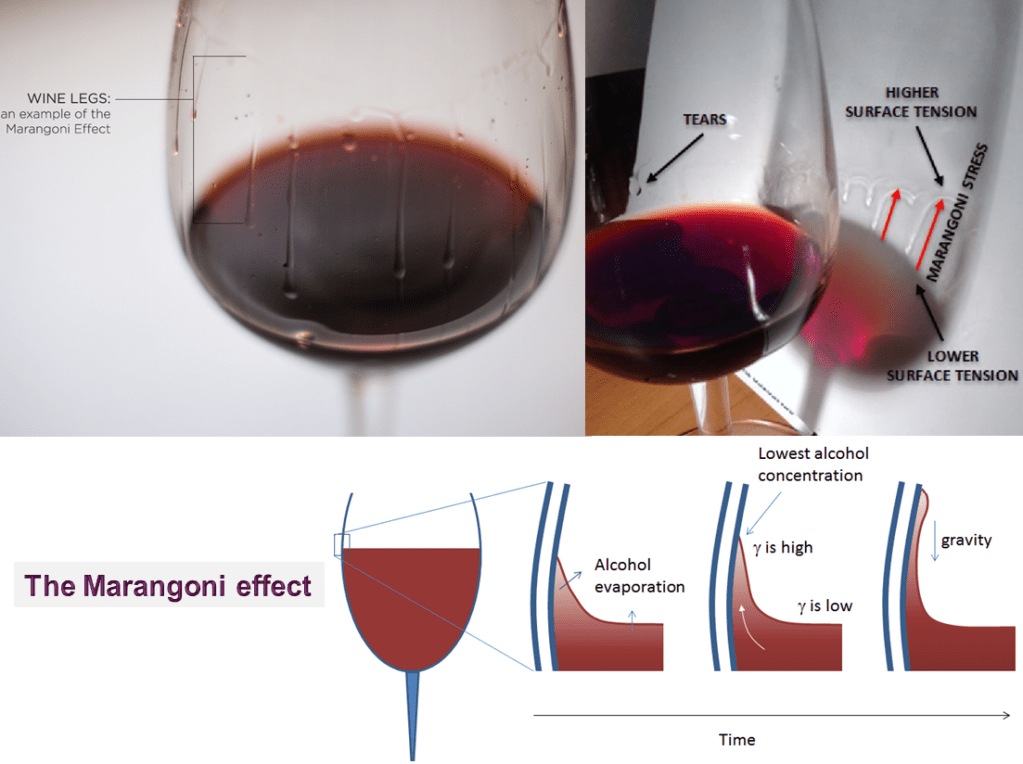
The ethanol in wine has the effect of lowering its surface tension with the glass so, when it´s poured, it leaves a this film. The alcohol in that coating quickly evaporates, leaving an area of liquid with a low concentration of alcohol, and thus a higher surface tension than the neighboring area. The unequal tensions pull the liquid apart, leaving a tear. The higher the alcohol concentration of the wine, the more pronounced this effect, so by looking at the Marangoni effect, you can get a sense of how alcoholic your wine is.
The taste of wine owes more to its appearance (especially the label) and its cultural associations than many wine experts would like to admit. Studies show that flavor is constructed in the brain, which takes inputs not just from the taste buds in the mouth and the sensors in the nose, but also from your brain´s expectation of what things should taste like.
For instance if you take strawberry ice cream, and use a flavourless dye to change its colour, making it, say, green, yellow or orange, then people who taste the ice cream will have difficulty detecting the strawberry flavor. More likely than not, they´ll taste flavours related to the colour. If the ice cream is orange, they´re likely to taste “peach”; if it´s yellow, “vanilla”; and often green will taste like “lime”. What´s perhaps most extraordinary about this, though, is that when I tried it myself, even when I knew the orange-coloured ice cream I was eating was strawberry, I still seemed to taste peach. Clearly, flavor is a multisensory experience, and as the brain constructs the taste of a food or drink using sensory inputs from multiple sources, sight is so dominant that it often overrides other sensory input.
There are many theories as to why flavor is so influenced by vision. One of the primary ones has to do with how our brain interprets fragrance. Flavor is constructed from smell, and our ability to detect smells is approximately 10 times slower than our visual detection. We have great difficulty identifying odours from specific molecules. This might be because single odours are recognized by multiple receptors in the nose. Even experts trained to detect particular molecular substances through smell fail to do so when these are mixed with 4 or 5 other smells. When you consider that wine has thousand of individual flavor molecules, the staggering challenge of wine tasting becomes evident. That our sense of smell doesn’t provide enough information to reliably distinguish between mixtures of odors is evident if you play a simple game.
TRY THIS: Blindfold your fellow dinner guests one evening and ask them to identify the liquids in a series of glasses that you pass to them (try orange juice, milk, cold coffee). The rules of the game are that they may only smell the substances, not taste or see them. Some drinks are easy but most are difficult for your senses to detect correctly. After this, do not reveal the answers but instead allow your guests to take off their blindfolds and now use smell and sight to identify the substances. This is much easier now that you can bring to bear your experience of seeing and smelling that particular drink in the past. The game illustrates just how much we rely on vision to identify smell, and thus taste.
The importance of vision in appreciating wine was demonstrated most dramatically in a scientific study carried out in 2001 in France. A panel of 54 tasters were asked to judge the bouquet of 2 wines and comment on them. Both were Bordeaux wines; one was a white, made from Semillon and Sauvignon grapes, and the other was a red, made from Cabernet Sauvignon and Merlot grapes.
But the participants didn’t know that a flavourless red dye had been added to the white. So far the participants could tell, they were smelling 2 glasses of red. The colour completely dominated their appreciation of the bouquet of the wines. Both wines were described by the participants using words like “spicy”, “intense” and “blackcurrant”, even though one was a white wine with a flavor profile that should not resemble these descriptors.
But no matter how we manipulate the colour of our drinks, when the flavor we taste matches what we expected based on the drink´s appearance, we tend to enjoy it more. Similarly, the bottle from which it is poured, the cleanliness and ambiance of the space we´re it, the attractiveness of the person serving us, and – especially in the case of wine – the association of sophistication and quality all change out drinking experience. Experiments have shown that we´ll like wine more or less depending on where the label says it was produced, and that we´ll enjoy it more if we hear something good about it before drinking – that it´s won an award, for instance. Rather a lot of wines win awards, by the way; there are many competitions where the vast majority of wines entered by the manufacturers win a commendation.
If you´re one of those people who think they don´t know anything about wine, and you feel bewildered when you´re handed a wine list in a restaurant, think about the unfamiliar names of the grapes, the countries of origin and the dates of production as you would specifications of a car. You may or may not care whether your car has a petrol or a diesel engine, or whether it has a 1.4-liter engine or 2.0-litre engine. These details may not be something you want to learn about.
You may just want a car to get you from A to B reliably, and that´s really all that matters to you. Most mid-priced wines will do this beautifully, the A to B in the case of wines being a pleasant accompaniment to food, or a vehicle to let alcohol shift your mood, or as a way to celebrate a birthday. But perhaps you´re someone who likes their car to do more than take you from A to B. Maybe you enjoy the sensation of getting there, screaming fast around corners for instance, or alternatively having a smooth floaty ride. Some wines are a vehicle for spikier flavours than others, while some, such as “natural” wines, really push the boundaries of what you expect a wine to taste like. These are not better wines; they are different wines, because all taste is subjective, and as with cars, (and most of life) price is no reliable guide to these experiences.
When you enjoy a wine, just like a ride in a car, you are enjoying a multisensory experience. Equally, if you buy an expensive brand of car, that´s really what you´re paying for – the brand, not the experience. Some people love having the most expensive cars, they get real enjoyment out of what that says about them as a person. It´s the same with wines. But this doesn’t mean that these are better wines or better cars, or even that the owners are more sophisticated people. Thus if having the most expensive wine doesn’t turn you on, then you´re wasting your money on €50 bottles of wine. Most mid-priced wines and many budget-priced wines have flavor profiles that are just as complex as top-priced wines – and blind testing shows this. One of the physiological effects of alcohol on the body is to inhibit the secretion of hormones that tell your kidneys to conserve water. If you don´t drink water to compensate, you become dehydrated.
 Computer Aided Design & The 118 Elements
Leave a comment