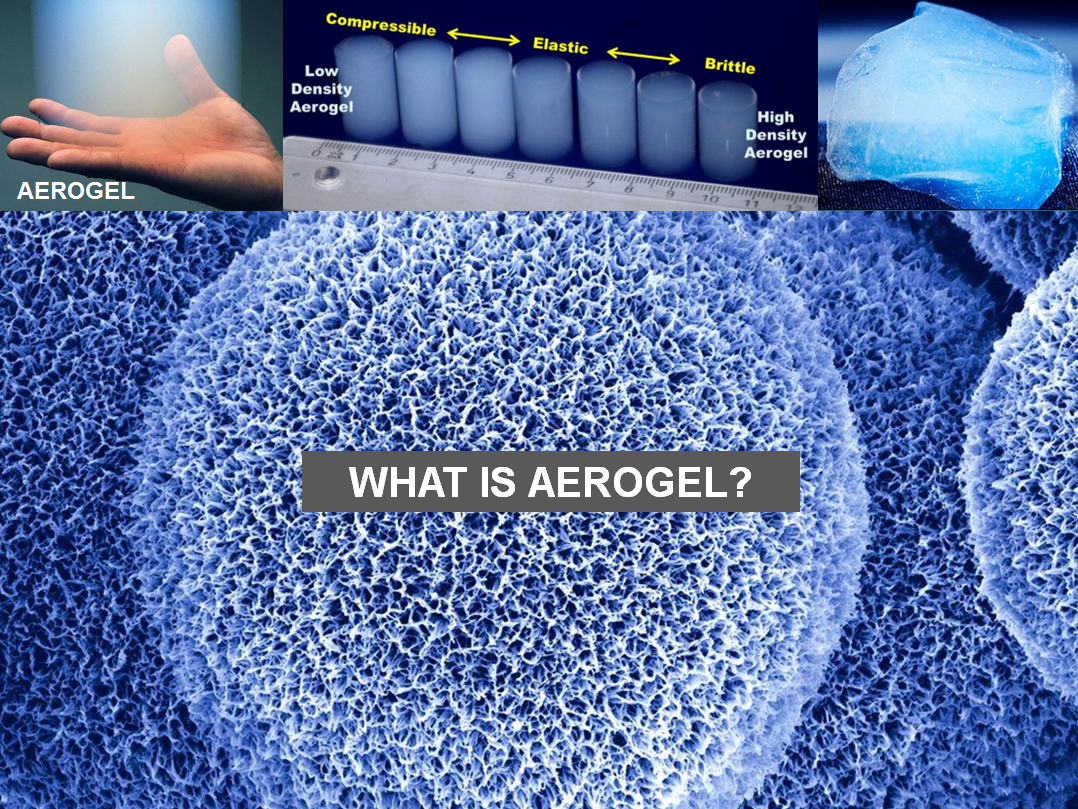
In a world where we say we value creativity and give out medals to reward its success, it’s odd that we still use gold, silver and bronze to do so. In a world where we have industrialized so many materials, including those we used to hold sacred, such as gold and diamond, I like to think there may again be a place for a material valued solely for its beauty and significance. For If ever there was a material that represented mankind’s ability to look up to the sky and wonder who we are, if ever there was a material that represented our ability to turn a rocky planet into a bountiful and marvelous place and why not other rocky planets as well where we can eventually live on; if ever there was a material that represented our ability to explore the vastness of the Solar System while at the same time speaking of the fragility of human existence , if ever there was a blue-sky material, that material is AEROGEL.
Most people will never hold a piece of aerogel in their hand, but those that do never forget it. It is a unique experience. There is no weight to it that you can perceive, and its edges fade away so imperceptibly that it is impossible to see where the material stops and the air begins Add to this its ghostly blue colour and it really is like holding a piece of sky in your hand.
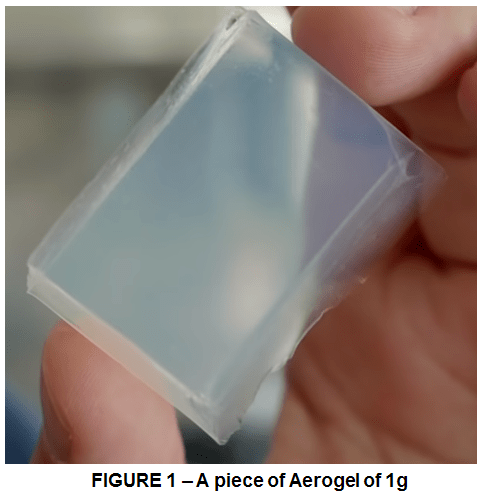
This is how a piece of this material feels and looks like, it is the most used type of aerogel called silica aerogel.
However not all aerogels are like silica aerogel and I will be talking about this next.
WHAT IS AEROGEL?
To understand what aerogel is, first let’s take a look at what a regular gel is. Gels, such as jelly (Jell-O, Gelatin, whatever you like to call it) and superglue, are quite remarkable substances themselves. They exhibit some properties, such as fluid density, that are characteristic of liquids; other properties, such as their fixed shape, which are only found in solids. The cause of their identity crisis lies in their internal structure. Hence a gel is neither a liquid nor a solid. It’s a liquid trapped in a solid matrix, it’s a kind of composite material.
Hence, gels are formed from a network of microscopic pores called nanopores. Through these pores, the liquid component of the gel flows. The pores are so small that capillary forces exerted by the liquid are strong enough to hold the whole thing together, and prevent the liquid from flowing out. The only problem for a gel is evaporation. The water inside the nanopores is essential to maintain the structure of the gel, but if it is left exposed to the air, the water will begin to evaporate out of it. As the water evaporates the gel begins to shrink, the internal structure collapses in on itself, and eventually the gel is reduced to xerogel – a hard, dry and dense substance less than a 10th of it’s original size. These Xerogels usually retain high porosity and an enormous surface area, along with very small pore-size distribution and they have important applications as pharmaceutical drug carriers.
In contrast, an aerogel is a gel which has had the liquid removed without the collapse of the nanopore structure; the solid internal framework is maintained, but the liquid interior replaced with air or other gas. Essentially, an aerogel it is a nanoporous sponge—structured very much like a kitchen sponge, except for with pores that are literally a million times smaller. We can say that aerogels are a form of nanotechnology because they are riddled with zillions of nanometer-scale nooks and crannies, most of which are about 10 nm across (only about 100 atoms wide!). For perspective, that’s about 10,000 times smaller than the diameter of a human hair. Accordingly, the branch-like struts that make up the solid part of the aerogel are also nanometer-sized. You can think of aerogels like solid dry materials (unlike “regular” gels you might think of, which are usually wet like gelatin dessert). The word “aerogel” refers to the fact that aerogels are derived from gels–effectively the solid structure of a wet gel, only with a gas or vacuum in its pores instead of liquid. By technical definition an aerogel is:
– a syntetic open-porous, mesoporous, solid foam that is composed of a network of interconnected nanostructures and that exhibits a porosity (non-solid volume) of no less than 50%.
The term “open-porous” means that the gas in the aerogel is not trapped inside solid pockets.
The term “mesoporous” refers to a material that contains pores ranging from <1 to 100 nanometers (billionths of a meter) in diameter and usually <20 nm.
In practice, most aerogels exhibit somewhere between 90 to 99.98+% porosity and also contain a significant amount of microporosity (pores less than 2 nm in diameter). Generally speaking, most of the pores in an aerogel fall within this size range. Typically aerogels are 90 -99% air (or other gas) in volume, with the lowest-density aerogel ever produced being 99.98% air in volume. As result the high gas content of Aerogels also gives them a variety of unique properties, including very low thermal conductivity, very high porosity and most notably extremely low density (which range from 0.0011 to ~0.5 g cm-3), this making Aerogels to be the world’s lightest solid materials.
AEROGELS IN GENERAL
Aerogel is occasionally referred to as “air glass” or “frozen smoke” but these are just nicknames. Brand names that refer to some commercial aerogel materials include Santocel® (obsolete), Nanogel®, Pyrogel®, Cryogel®, and Spaceloft® – each of which consists of aerogel with a different formulation and composition. Furthemore, aerogels are most definitely not aerosols, which are colloidal sprays such as those used for hairspray. Even if aerogels in general are ultra light materials, that doesn’t mean every aerogel is the world’s lightest solid. Aerogels are a diverse class of materials, and come in a range of densities, compositions, sizes, and properties. The term aerogel does not refer to a particular substance, but rather to a geometry which a substance can take on.
The structural framework of Aerogel is typically composed of silica, so silica aerogel is often referred to as simply “Aerogel.” (as shown in figure 1 above). But just like plastics, ceramics, and metals, there are lots of different types of aerogels. The same way a sculpture can be made out of clay, plastic, papier-mâché, etc., except silica, aerogels can be also made of a wide variety of substances, including:
- Most of the transition metal oxides (for example, iron oxide, titanium oxide, chromium oxide, vanadium oxide etc)
- Most of the lanthanide and actinide metal oxides (for example, praseodymium oxide holmium oxide, erbium oxide, neodymium oxide, samarium oxide etc)
- Several main group metal oxides (for example, tin oxide, aluminium oxide)
- Organic polymers (such as resorcinol-formaldehyde, phenol-formaldehyde, polyacrylates, polystyrenes, polyurethanes, and epoxies)
- Biological polymers (such as gelatin, pectin, and agar agar)
- Semiconductor nanostructures (such as cadmium selenide quantum dots)
- Carbon and carbon nanotubes
- Metals (such as copper and gold)
- Aerogel composites, for example aerogels reinforced with polymer coatings or aerogels embedded with magnetic nanoparticles, are also routinely prepared.

However, regardless of the material used to create any of these, the preponderance of air in an Aerogel’s structure gives it a nearly transparent appearance. This material has almost unlimited potential, believing that they might find application in most human activities and areas. For instance, due to the special properties, the aerogels can be used in building applications as thermal and acoustic materials and, also in a wide range of other domains e.g. absorbents, shock absorbers, nuclear waste storage, space applications, batteries and catalysts etc.
 Computer Aided Design & The 118 Elements
Leave a comment