Antimatter is at the center of one of the biggest mysteries: why isn’t there more of it in the universe? The established wisdom is that the energetic fireball of the Big Bang 14 billion years ago spawned matter and antimatter in perfect balance.This transubstantiation of radiant energy into particle and antiparticle is not a one way voyage; if these opposites subsequently come into contact, they annihilate one another, the energy that was previously trapped within them being liberated as gamma rays. In the dense cauldron of the infant universe such collisions would have been very common, and the newborn material would not have lasted long. If in the first moment matter and antimatter emerged equally from the Big Bang, an instant later they should have annihilated one another.This gives another perspective on the question. The mystery is less about why antimatter has disappeared, and more a question of why has matter survived?
Perhaps the answer is that there is some difference between them, that they are not perfect mirrors of one another. In the arcane world of strange and bottom flavours we know that there are subtle differences, but the basic electrons, protons, and neutrons appear to be matched precisely by their antiparticle opposites. If there is any difference, it is beyond our ability to measure. Everything about them appears to be as the English physicist Paul Dirac predicted: “particles of normal matter and their antiparticles are in perfect counterpoint.“
Although antihydrogen atoms are the most detailed ‘anti’-matter clusters yet seen, theory and experience imply that all atomic elements can exist in ‘anti’ form. As the periodic table lists the atomic elements which are made from electrons surrounding nuclei containing protons and neutrons, so will an anti-periodic table of anti-elements emerge from swarms of positrons surrounding antinuclei containing antiprotons and antineutrons. The rules of quantum mechanics that explain the stability of atoms of matter imply the same stability for atoms of antimatter. The signs of the electrical charges have been reversed, but the laws of attraction of opposites and repulsion of like charges remain the same. The complex interactions that make amino-acids, DNA, and life will equally allow anti-elements to make everything in anti-DNA, even anti-life.
The chemistry of antimatter is the same as matter: antiplanets and antimatter in all its forms are as realizable as the more familiar matter which dominates the known universe. Are antigalaxies of antistars surrounded by antiplanets of anti-matter awaiting unsuspecting astronauts in the far reaches of the universe? How sure are we that there is no antimatter at large, out there somewhere?
Earth is not like the universe at large. For example, hydrogen (H) is rare on Earth but is the commonest element in the universe. Stars like our Sun are mostly hydrogen, slowly cooking the seeds of the heavier elements, but if you selected at random a volume of the universe that is millions of light years in diameter, atomic elements such as carbon (C), nitrogen (N), and oxygen (O), iron (Fe), silver (Ag), and gold (Au) would be all but absent.
We are atypical as regards the abundance of the elements, and the same could be true as regards antimatter. So it is one thing to admit that there is no antimatter hereabouts, quite another to suppose that this is true everywhere and that the entire material universe is made of matter to the exclusion of antimatter. How can we know the make-up of a distant star, seen only as a faint candle across the vastness of space? We cannot. All we see from Earth is the starlight and as we have no reason to suppose that the spectra of the anti-elements are any different from those of the elements, we cannot tell stars from antistars simply by looking out into the night sky.
Astronauts have landed on the Moon, as have robotic probes on Mars without being annihilated, so we know that there is no antimatter up there. The whole solar system is bathed in the solar wind, the stream of subatomic particles emitted by the sun. If the sun were an antistar and the solar wind consisted of antiparticles, we would detect the gamma rays produced when these antiparticles annihilated with the matter of the planets. But we see no such gamma rays. This also shows the nonsense of some cults who believe that comets are made of antimatter. As anticomets pass through the solar wind, the amounts of gamma ray emission would be enormous, each gram of annihilation liberating twice the energy of an Hiroshima-sized atomic bomb.
Launched in 1985 as the ESA’s first deep space mission, the Giotto probe successfully transmitted images from inside Comet Halley, showing for the first time the shape of a comet nucleus and found evidence of organic material in a comet, again with no track of antimatter at all. If there are anticomets and antimeteorites, they make up less than 1 part in a billion of the matter in the solar system.
When stars explode, their bits and pieces are ejected into space, and if trapped by the magnetic arms of our planet they crash into the upper atmosphere as cosmic rays. As the positron was discovered in cosmic rays, and as antiprotons also have been seen there, it may be tempting to think that these antiparticles a remnants of antistars that exploded far away. On the contrary, these positrons and antiprotons are the debris formed from the energy released when a high-energy cosmic ray made of ordinary matter hits gas in the upper atmosphere. Had an antistar exploded and permeated the cosmos with anti-elements then these also would be present, but one more time no anti-elements or antinuclei have turned up so far in the cosmic rays in earth’s atmosphere.
Searches for antimatter in the rays above the atmosphere are being made by the AMS (Alpha Magnetic Spectrometer) satellite, and by a balloon that floats to the edge of space above the south pole. However none has been seen, not even anything as simple as antihelium, in contrast to the abundance of individual positrons and antiprotons. Perhaps these anti-elements have been destroyed en route? While this is possible there is no evidence for it. There would be distinctive gamma ray bursts coming from the annihilation of positrons by electrons in the interstellar medium, and the annihilation of antiprotons also would give themselves away. Admittedly interstellar space is nearly a vacuum but it is by no means utterly empty, so if antimatter were to travel for several light years it would bump into something sooner or later and be revealed. In addition there are millions of galaxies distributed throughout the heavens, some of which have close encounters and are distended as the tidal forces of gravity tug on their individual stars. If any of these colliding galaxies were made of antistars there would be distinctive gamma ray bursts at the boundary, but, again, none have been seen.
All signs of antimatter appear to be due to its transient creation from collisions involving ordinary matter, such as between cosmic rays and the atmosphere. For 30 years gamma rays coming from the centre of our Milky Way galaxy have signaled that there are clouds of positrons there. In 2008 ‘Integral’, a gamma-ray telescope on a satellite, discovered that these positrons are in the neighborhood of X-ray binary stars. These are ordinary stars that are being eaten alive by neutron stars or black holes. The gaseous material of the dying star spirals in towards the cannibal, becomes exceedingly hot and pairs of electrons and positrons form.
Closer to home, a large solar flare in 2002 produced high-energy particles, which collided with slower particles in the solar atmosphere and created positrons. It is estimated that up to half a kilogram of positrons were produced; if that energy could be recovered by their subsequent annihilation, it would be enough to power the UK for two days.
For more than a decade an experiment on the International Space Station has been detecting matter and antimatter from cosmic rays above the Earth’s atmosphere. Any such antimatter would have a cosmological origin. Atomic nuclei and antinuclei from antimatter have opposite electric charges and a magnet in the AMS (Alpha Magnetic Spectrometer) experiment would deflect them in opposite directions. Observation of an antihelium nucleus would be evidence for a large amount of antimatter existing somewhere in the universe, but none has been seen.
There does appear to be an excess of high-energy positrons, however, whose source is yet to be identified. All of the evidence suggests that, with the exception of transient antiparticles produced like the above, everything within several hundred million light years of us is made of matter. This is a huge volume, to be sure, but only a fraction of the visible universe. There is still a lot of unexplored space where antimatter could dominate.So the next question is: Could matter and antimatter have become separated into large independent domains?. We simply don’t know this and we’ll never find out.
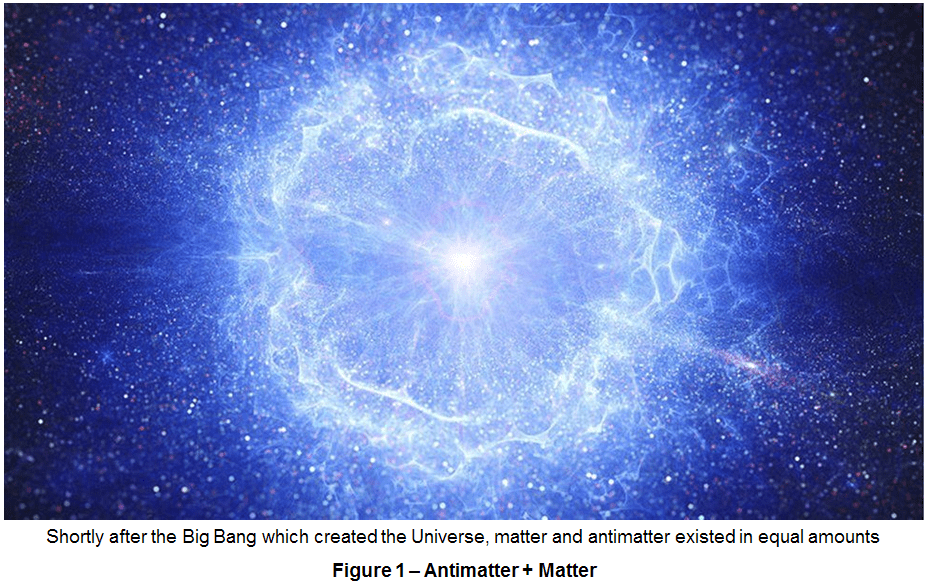
The universe as we see it today is the cold remnant of its original creation in the hot Big Bang, and when things cool, their nature can change: water freezes into snowflakes, metal becomes magnetic. Analogously, separated regions of matter and antimatter could have emerged as the universe cooled. Immediately after the Big Bang, the baby universe would have been a froth of radiant energy, matter and antimatter continuously being created and destroyed. The universe aged and cooled until it was no longer hot enough to replace the annihilated matter and antimatter with new stuff. By the natural rules of chance there would have been some regions where there was a slight excess of matter and other regions with a slight excess of antimatter. As the universe cooled further stars and elements would emerge as the basic particles glued to one another in the matter dominated regions, and antistars would appear in the antimatter domains. Although this remains a possibility, most models of the universe disfavour it. The received wisdom is that the entire observable universe (estimated at a radius of 46 billion light-years away from Earth) of is made of matter to the exclusion of antimatter. On the average every 5 cubic metres of outer space contains 1 proton, no antiprotons and 10 billion quanta of radiation.
Everything that we know about the early universe, from theory, observations and the results of experiments at LEP (The Large Electron-Positron Collider), suggests that in the hot aftermath of the Big Bang those numbers would have been 10 billion quanta of radiation, 10 billion antiprotons, and 10 billion and 1 protons. The inference is that one of the first acts after creation was a Great Annihilation such that the matter-dominated universe today is made from the surviving 1 out of 10 billion protons. Everything out there today is the remnant of an even grander creation. If this is so, then something must have happened even earlier than that to tip the balance in favour of protons over antiprotons at a level of one part in billions. Something must differentiate between normal matter and antimatter. To discover what this might be, and how the imbalance between matter and antimatter first came about, we need first to understand how matter as we know it today emerged from the Big Bang.
 Computer Aided Design & The 118 Elements
Excellent post 🎸🎸
LikeLiked by 1 person