Periodic Table of Elements represents our knowledge about matter. There is still a lot to learn about and new stuff to discover but in general we are quite familiar with matter. We know well that ordinary matter is the familiar stuff, which makes air, rocks, and living things. But the opposite as we call it Antimatter is rather unfamiliar. It’s not a big deal to define it.Antimatter is exactly as its name says, it’s the matter’s faithful opposite, identical in all respects except that deep inside its atoms everything is back to front. This is exactly what antimatter is, the antithesis to matter.
We can also have for example, the Periodic Table of Antielements. All the with the same characteristics like the ordinary 118 known elements but with different polarity for everything related to electric charge, magnetism and quantum states. So it shouldn’t be that much different. But it is.
To the current day we know what Antimatter is, we know how it interacts with matter, we know how to produce it here on Earth and how it is produced in Nature – basically it can occur or be made under very special conditions in microscopic amounts. It also exists for very short period of time because it quickly interacts with ordinary matter. But what we still don’t know yet is why all stuff in the universe – planets, stars, galaxies are predominantly NOT antimatter.
HOW DOES ANTIMATTER OCCUR IN NATURE?
Antimatter occurs regularly in 3 conditions:
- Radioactive decay;
- Extremmelly high temperatures (more than 10 billion °C) and
- High-energy particle collisions.
As far as we can tell today antimatter does not exist in macroscopic amounts, a vanishing act that is one of the unexplained mysteries of the universe. But we know that antimatter is real because scientists have made small pieces of it. Particle colliders such as the one used at CERN in Geneva, have produced positrons, antiprotons, antineutrons, anti-nulei, even antihydrogen and antihelium.
Although antimatter in bulk – even extremely small bulk- doesn’t exist hereabouts, nonetheless some natural processes produce fleetingly the simplest example, the positron, the antiworld’s mirror of the electron.
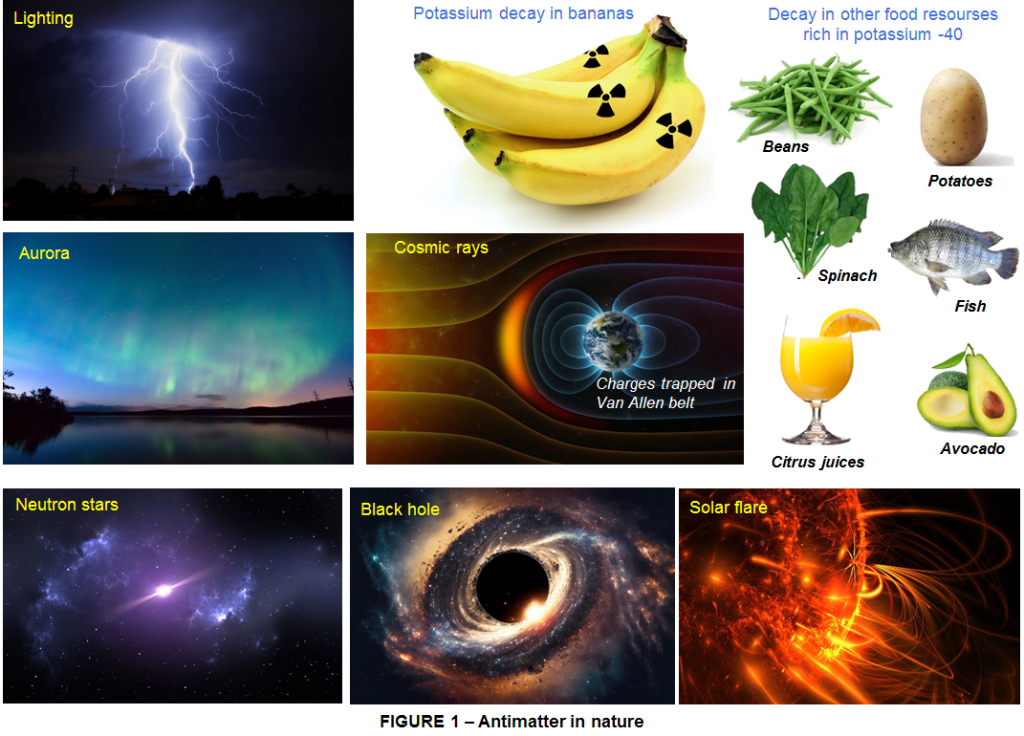
Lighting for instance produces positrons which react with matter to generate some gamma radiation. Cosmic rays contain positrons and some antiprotons. Solar flares may release antiprotons as well which become trapped in the van Allen radiation belt and can cause an aurora. Neutron stars and black holes produce positron-electron plasma. Even Bananas, the human body, and other natural sources of potassium-40 release positrons from β+ decay. These positrons react with electrons and release energy from the annihilation, but the reaction poses no health threat. So Antimatter is a real substance and not just a science fiction topic.
As the electron, the lightest electrically charged particle, is found in the atoms of all matter, so the positron, its antimatter counterpart, is potentially an essential piece of anti-atoms in the antiworld. In our world many elements are radioactive. The periodic table currently includes 118 elements, from which only 92 are found to occur more or less naturally, the last stable atom of these being Uranium as the element 92. The rest of 26 elements a.k.a. transuranium elements are unstable, they are artificially made and the nuclei of their atoms are spitting out energy spontaneously as their constituent pieces rearrange themselves to form more stable assemblies. The atomic nuclei of some of these elements are known as “positron emitters”.
The positron did not pre-exist within an atom any more than a bark exists inside a dog, it was the energy release that created it. The positron flies away from the atom and lives only so long as it avoids meeting an electron. As our world is made of atoms, which all contain electrons, the positron soon bumps into one, these counterbalanced opposites disappearing in a flash of gamma rays, which is light far beyond the part of the spectrum that our eyes can see. On a larger scale, nature produces positrons in the heart of the Sun. The sunlight that shines on us today is in part a result of positrons that were created in the centre of the Sun some 100,000 years ago, only to be annihilated almost immediately. The Sun is mostly hydrogen, the simplest element in the universe as we know it in our realm of matter. In the Sun’s centre where the temperature exceeds 10 million °C , the hydrogen atoms are disrupted into their component pieces, electrons and protons swarming independently and at random. The protons occasionally bump into one another and through a sequence processes link together, eventually forming the seed of helium, of which is the next simplest element. Helium is the ash from this fusion reaction and has less mass than the protons that were used to make it. This loss in mass has turned into energy, E = mc2 at work, which is ultimately the energy that emerges as sunlight. So what do positrons have to do with this?
A helium nucleus contains two protons and two neutrons. Under suitable circumstances a proton can change into a neutron and emit energy some of which materializes as a positron, similar to what happens in the positron emitters of earthly medicine such as in PET (Positron Emission Tomography) scanning. The positron finds itself in the heart of the sun, where there are lots of electrons, and is instantly destroyed, turned into gamma rays. These try to rush away at the speed of light but are interrupted by the crowd of electrically charged particles, electrons, and protons that form the seething star. Buffeted this way and that, repeatedly absorbed by electrons and then emitted with less energy than before, it will take a hundred thousand years before gamma rays manage to reach the surface, hundreds of thousands of kilometres above. In doing so the rays lose lots of energy, their character changing from X-rays to ultra-violet and at last into the rainbow of colors that are visible to our eyes. So daylight is the result of antimatter being produced in the heart of the sun and, in part, of its annihilation.
This is not just a story of antimatter in history; The fusion processes that power the sun are producing positrons as you read this, and they are being annihilated faster than you can reach the end of this sentence. The gamma rays that were made just now are already wending their way upwards, eventually to emerge and illuminate the earth a thousand centuries from now.
WHY IS ANTIMATTER SCARCE IN THE UNIVERSE THOUGH?
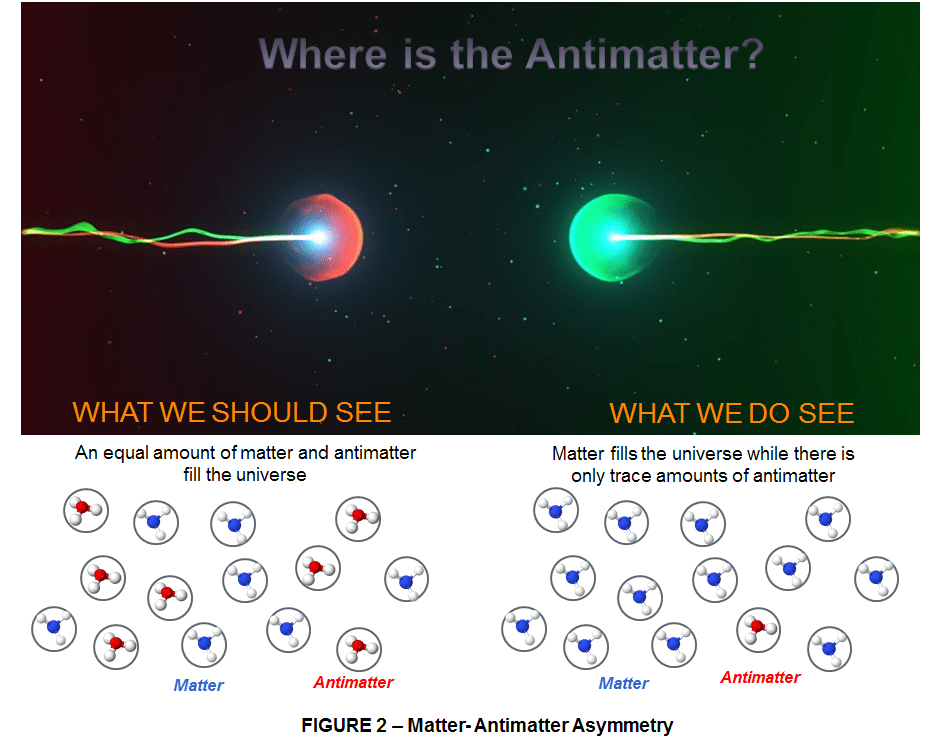
Antimatter has been a source of profound insights into physics for almost a century by now. We know almost everything about antimatter except its rarity. Understanding why this is the case will definitely teach us new physics. Therefore the observable universe we have today consists almost entirely of ordinary matter, with very little antimatter. In other words, it is asymmetrical with respect to matter and antimatter. Why is this so? We just don’t know. It’s possible the amount of matter and antimatter wasn’t homogeneous when the Big Bang happen, so most of the matter and antimatter annihilated each other. If this happened, it produced a lot of energy and either a (relatively) small amount of ordinary matter survived or the universe consists of pockets of matter and antimatter. If the latter event occurred, we might find distant antimatter galaxies.
Antimatter galaxies, if they exist, would be hard to detect because they would have the same chemical composition, absorption spectra, and emission spectra as regular galaxies.The key to finding them would be to look for annihilation events at the border between matter and antimatter. This issue is so important in physics that it even has its own name: The matter-antimatter asymmetry problem.
This story is currently being written in major particle physics labs in the world such as CERN in Geneva , Switzerland. With so much effort being put, it is only a question of time before the matter-antimatter asymmetry is answered. Addressing this issue requires that we delve into cosmology and high energy physics, also known as particle physics.
The solution to the above problem is still being worked out by physicists as we speak. Nevertheless, I will try to get a very simplified version of the known parts of the answer. The theoretical framework within which to understand the matter-antimatter asymmetry is 3-pronged and was already formulated over 50 years ago by the Russian physicist Andrei Sakharov. Therefore our quest on this begins right at the beginning: the Big Bang. As you know The Big Band is the instant when out universe was born. And as I said earlier Antimatter is the opposite of matter, from which stars and planets are made.
The 1st. PRONG = Both matter and antimatter were created in equal amounts shortly after the Big Bang event which formed our Universe.
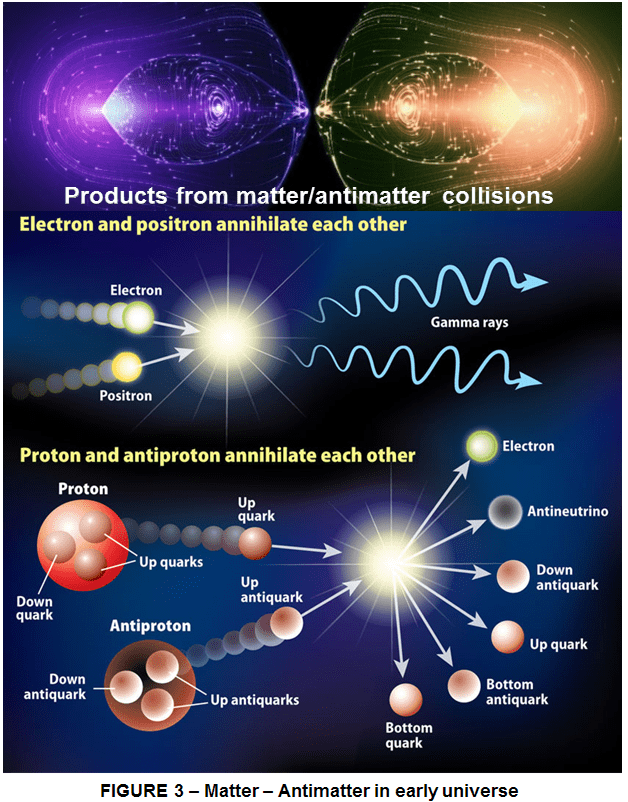
For every particle there was an antiparticle, for electron there was a positron, for every quark there was an antiquark. Mind you, protons and neutrons formed much later. They formed a few minutes after the Big Bang at which time almost all antimatter had disappeared. During the first fraction of a second after the Big Bang the Universe was an extremely hot soup of particles and antiparticles and intense radiation. Particles and antiparticles annihilated each other to produce highly energetic photons, and the energetic photons could interact with each other to produce again particle-antiparticle pairs, all happening under the watchful eyes of the laws of particle physics. The universe would have remained in this fiery thermal equilibrium for eons without anything interesting happening had it not been for an astounding cosmological fact. The Universe is expanding since its inception. This expansion of the Universe leads to cooling. The energy of radiation released after the Big Bang, decreased to a point where photon interaction were no longer energetic enough to produce particle-antiparticle pairs. The result is that the refueling of the abundance of pairs stopped. If no other processes had interfered the particles and antiparticles would have annihilated each other with time and we would have been left with a universe filled only with photons and no matter or antimatter at all. We wouldn’t’ be here to discuss it. The effect of the expansion of the Universe is to stop particle-antiparticle pairs from being replenished. Now other high energy physics process must come into play to produce the matter-antimatter asymmetry.
The 2nd. PRONG = A quantity is said to be conserved if its value before the reaction is the same as after the reaction.
If you recall, the antiparticle have the opposite charges to particles. Therefore huge energy of physic reactions have to conserve the total energy, momentum, charge and quantum numbers (particularly the lepton and baryon numbers). All the laws of high energy require that the above mentioned quantities be strictly conserved, or at least so it seems. The very absence of antimatter in the universe requires that the conservation of quantum numbers must be violated to some extend under certain condition in order to produce the matter-antimatter asymmetry observed in today’s universe. To what extent? To about 1 part in 1 billion. How do we know that?
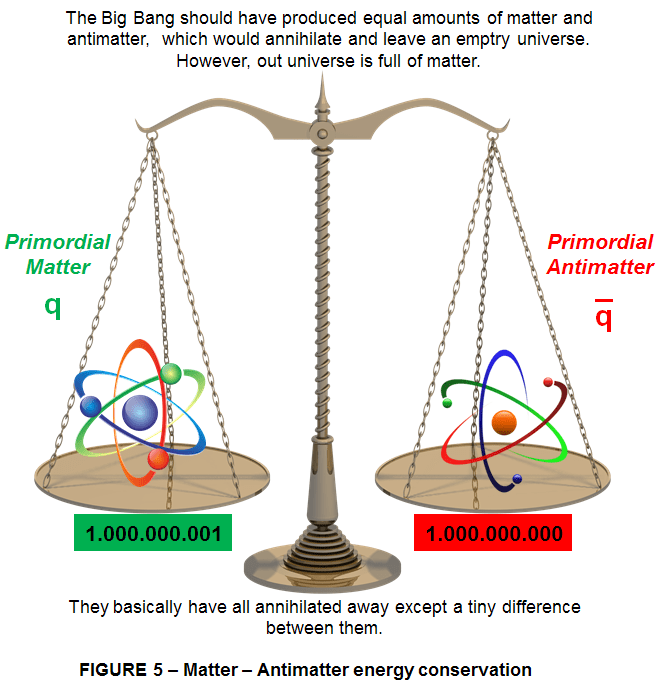
Astrophysicists know that there are roughly a billion photons for every particle in the Universe. This means that for every billion and one particles, there were only a billion antiparticles out there. The billion particles will annihilate with the billion antiparticles leading roughly to a billion photons, with the upshot being that when all is said and done we will have ONE particle and a billion photons, as the particle/photon ration observed by astrophysicists. However there is no evidence yet in particle physics labs of the violation of quantum numbers conservation. Moreover there is no theoretical process within the accepted paradigm of particle physics, the standard model, in which the quantum numbers (such as baryon number) is not conserved. Evidently, gaining a full understanding the matter-antimatter asymmetry requires new physics.
The 3rd. PRONG = The laws of physics, including conservation laws, should be the same if you were to change the size of the charges, C, of all the particles involved in reaction and look at the reaction through a mirror (P: parity).
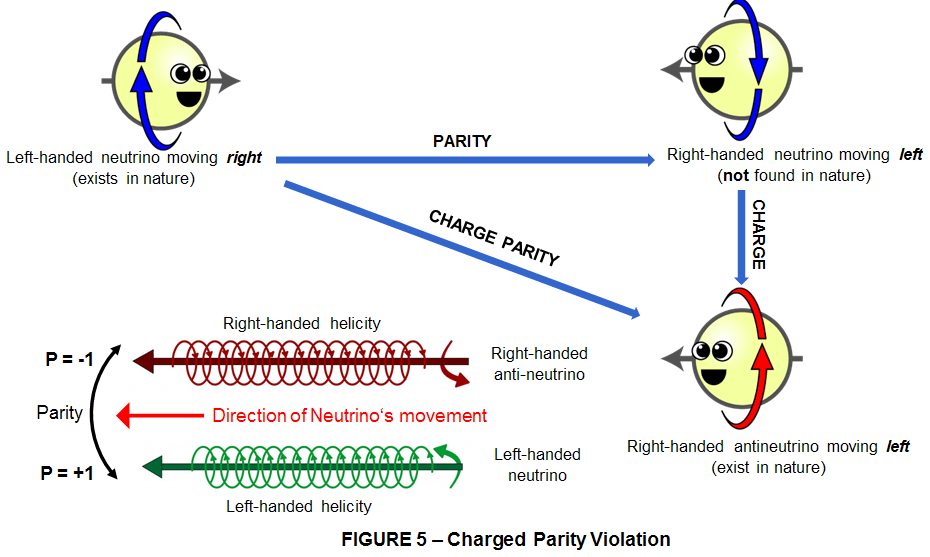
In order to understand the matter-antimatter asymmetry we must understand the process of CP (Charged Parity) violation. CP violation occurs when the outcomes of a reaction change upon inverting the sign of the charges and taking the mirror image of the reaction; CP violation is needed to produce more particles than antiparticles in the very early Universe. Glimpsed of CP violation have been observed in particle physics labs since the 1980s in reactions involving K-mesons (referring to as kaons) and other sub-atomic particles. However the amount of detected violation is not enough to explain the full magnitude of the matter-antimatter asymmetry. Naturally, more experiments are still needed!
 Computer Aided Design & The 118 Elements
Leave a comment