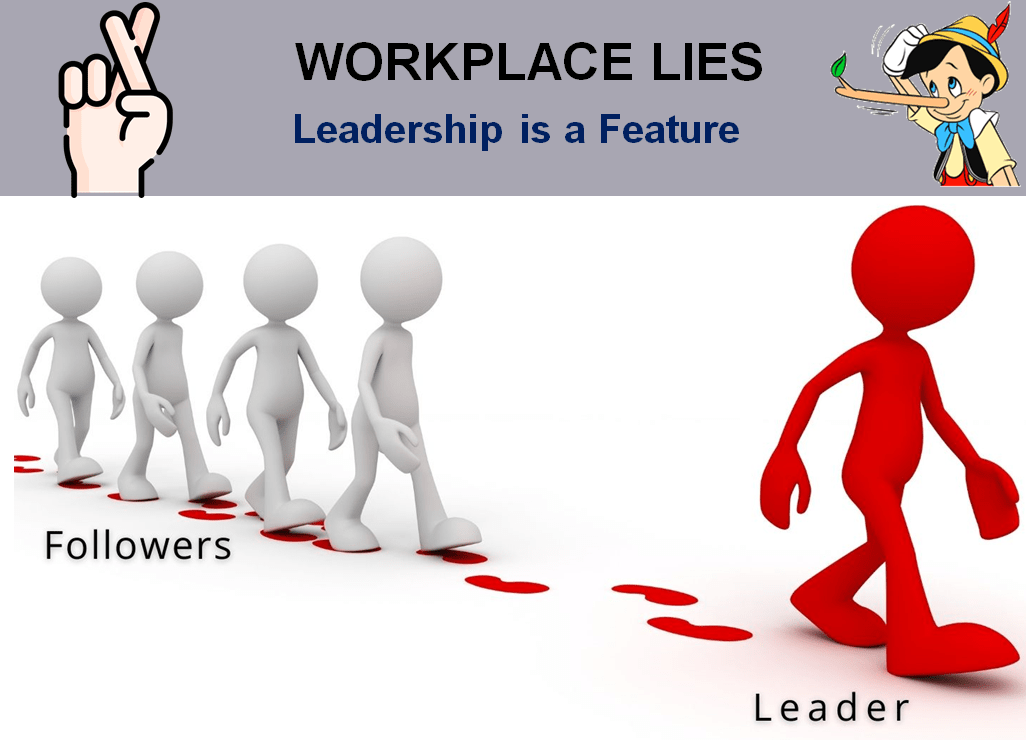
This article is not about Leadership. Yet it is about the frequent lie told at workplaces, namely that THE LEADERSHIP IS A FEATURE. If you would randomly ask 100 people you meet on the street: why they work for a company? the majority of them will tell you that it’s because they have to. Very few will tell you they go to work because they are passionate about it and they work there because it’s what they want. So then, why do we behave like that?
Well … it’s not hard to find why. This is the result of the education most of us we get from the schools we attend. Schools don’t teach you how to do something you love and especially they don’t teach you about money at all. You definitely get no financial education at school, all they teach you is how to go to work because you “have to”. As result making many of us to think that we must obey to those who lead, because we are told that LEADERSHIP IS A FEATURE.
Apparently there is a broad agreement that certain people exhibit a definable, consistent, and meaningful quality called “leadership”. That there are some characteristics of a person that are in some way above and different from that person’s technical skills (whether he or she can write good code, for example, or communicates good in English) and that also transcend that person’s interpersonal or “soft” skills (whether he or she can make the sale, or negotiate a deal) and that make the person a leader.
Therefore we tend to agree that all the best leaders possess this quality, or set of qualities – so, leadership is something that lives, specially, in those who lead and is in some way responsible for their ability to do so. As a consequence, most of us would agree that if you want to be a leader, you have to have this set of qualities. There is a frustrating circularity to this argument – that there’s a feature called “leadership“, and we know it’s a feature because leaders have it, otherwise they wouldn’t be leaders. It’s like saying your cat has catness because he’s a cat: it might be true, but it’s hardly helpful to your hamster if he dreams, someday, of being a cat.
This know-it-when-we-see-it vagueness explains, in part, why we can talk about leadership so much without usefully advancing our understanding of it, or “getting much better at it”. Perhaps to combat this vagueness, some go further and begin to try to specify some of the qualities that make up leadership. As for example:
- Being inspirational seems to be important.
- Being able to create and articulate a vision matters a lot.
- The ability to formulate strategy is good, as is the ability to distinguish a good strategy from a bad one.
- Sometimes mastery of execution makes the list – the art of getting stuff done.
- Setting a direction for an organization is important, and, in concert with this, bringing people into alignment with that direction and motivating them to move ahead.
- Decision making is high on the list, together with managing conflict.
- Innovation and disruption usually put in an appearance.
- Communications skills also rank highly, and having what’s commonly referred to as “executive presence” is also felt to be critical.
To this collection of long-limbed characteristics are added some personal traits. Leadership requires at least 2 things:
- authenticity (the ability to come across as a “real” person) and often, too,
- vulnerability (the courage to be imperfect in public, to relinquish the need to be right or to be the smartest person in the room).
These things, and a few others, are said to be needed so that our leaders can build effective relationships with others. And yet these characteristics are curiously circumscribed: authenticity is important, right up until the point when the leader, authentically, says that he has no idea what to do, which then fractures his vision. Likewise, vulnerability is important until the moment when the leader’s comfort with his own flaws causes us to doubt him, and to question whether he is sufficiently inspirational.
Apparently, we require authentic sureness and reassuring vulnerability, however contradictory those things may be. The personal qualities that make the list are Goldilocks qualities-they must be neither too hot, nor too cold, but just right. These little inconsistencies, however, melt away in the face of our conviction that leadership is a great good at work – it is always better for a person to have more of it, and the more leaders an organization has, the better. This much, at least, appears settled – and as a result you will be told that the most important thing you can do to advance your career is to “grow your leadership.”.
Now, some might choose other attributes for their lists, but those above are a reasonable summary of the theory-world view of leadership. And the reason that this isn’t a post on leadership is not that the qualities listed aren’t useful (they are) or that this topic has been done to death (it’s close) but, rather, that when I look critically, I realize that we may well have misunderstood leadership altogether. Indeed, the lie that we encounter at work is that leadership is a feature. Well it is NOT.
What does it mean for all the models and lists if the things on them are optional? The lesson from the real world is not that there is any particular collection of qualities that every leader has, but rather that every leader we can think of has obvious shortcomings-that leaders aren’t perfect people, not by a long way.
As with some of the great performers – think Lionel Messi and his amazing left foot – we don’t see the most respected leaders spending much time trying to round themselves out, trying to develop abilities in areas where they have none. Instead, we see them trying to make the best use of what they already have, with the result that whenever we look closely, we see them going about the task of leading in very different ways. In this way, leading is the same as all other fields of human endeavor-high performance is idiosyncratic, and the higher the level of performance the greater the level of idiosyncrasy. This is why the idea that “leadership is a feature”is a lie. When you take any of our definitions of that feature, and then try to locate it in the real world, you encounter exception upon exception upon exception. The very least I can conclude is that if there is some magical set of attributes, we haven’t yet figured out what they are, and that plenty of leaders are doing plenty of leading without many of them. And if that’s the case, then the things that supposedly make up leadership neither add to our understanding of it nor help us be better at it.
You are indeed a leader if your followers can confidently confirm the following 8 statements:
- I am really enthusiastic about the mission of my company.
- At work, I clearly understand what is expected of me.
- In my team, I am surrounded by people who share my values.
- I have the chance to use my strengths every day at work.
- My teammates have my back.
- I know I will be recognized for excellent work.
- I have great confidence in my company’s future.
- In my work, I am always challenged to grow.
We don’t need to dictate how each leader should behave, but we can define what all good leaders must create in their followers. And since we measure this by asking the followers to rate their own experiences, rather than rating the leader on a long list of abstract leader qualities, this measure of leader effectiveness is reliable.
Leadership isn’t a thing, because it cannot be measured reliably. Followership is a thing, because it can.
It’s a lie that leadership is a feature because no two leaders create followers in quite the same way. What’s true in the real world is that leading is many different things. Your challenge as a leader is not to try to acquire the complete set of abstract leader competencies – you will fail, not least because the first hurdle you will fall at is authenticity. Instead, your challenge is to find and refine your own idiosyncratic way of creating in your team these 8 emotional outcomes as I’ve mentioned earlier. Do this well and you will lead well.
Interestingly and happily – these two features are also linked. Your ability to create the outcomes you want in your followers is tied directly to how seriously and intelligently you cultivate your own idiosyncrasy, and to what end. The deeper and more extreme your idiosyncrasy becomes, the more passionately your followers follow-and while this is frustrating to us when we happen to disagree with the ends of a particular leader, it is so nonetheless.
When Martin L. King was in jail in 1960 in Birmingham Alabama due to some accusations that he organized a nonviolent campaign against segregation he had written what is now known as the Letter from Birmingham Jail. It’s a long letter-an impassioned letter. It’s a plea against settling, against compromise, against the path of least resistance. And in it, King talks about extremism. “The question,” he says “is not whether we will be extremist, but what kind of extremists we will be.”
Warren Buffett, the uninspiring Coke – drinker from Omaha, is an extremist. He’s exceptional at finding and buying companies. Winston Churchill, while he might have been a poor policy maker, was exceptional at inspiring uncompromising resistance. Susan B. Anthony was really good at focusing her energies, and those of the people around her, on a specific goal. Steve Jobs was really good at creating hardware and software that was delightful to use. George Patton was really good at fighting, with his whole being, whatever was in front of him on any given day. And John F. Kennedy was really good at making the future feel universal and morally uplifting. What each of these leaders had in common was that they were really good at something – each was, in their different way, an extremist.

 Computer Aided Design & The 118 Elements
Leave a comment